
Woody Encroachment
Cedars/Junipers Put More Acres at Risk of Wildfire Spread
WIND SPEED: 40 mph
FUEL MOISTURE: 7-9%
Maximum Spot-fire Distances
Under different levels of cedar encroachment
Acres Around Ignition at Risk of Spot-fire
Under different levels of cedar encroachment
Donovan et al. 2023 Spot-fire distance increases disproportionately for wildfires compared to prescribed fires as grasslands transition to Juniperus woodlands.
https://bit.ly/SpotfireJuniper
University of Florida, at Milton
Nebraska Agronomy and Horticulture
Woody Encroachment
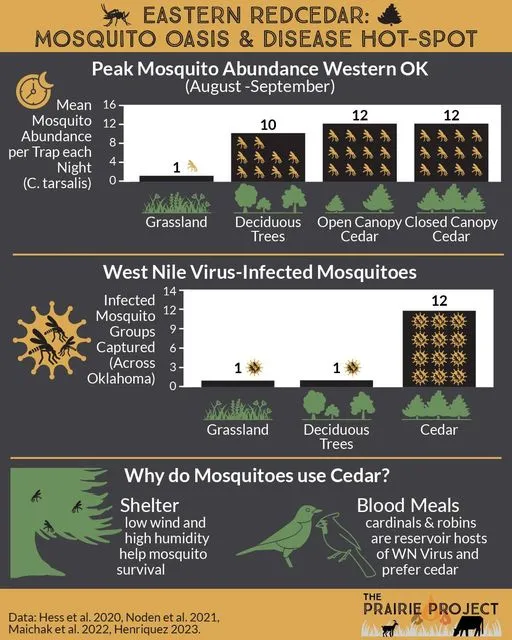
Eastern Redcedar: Mosquito Oasis & Disease Hot-Spot
Peak Mosquito Abundance, Western OK (August - September)
Mean Mosquito Abundance per Trap each Night (C. tarsalis)
Grassland: 1
Deciduous Trees: 10
Open Canopy Cedar: 12
Closed Canopy Cedar: 12
West Nile Virus-Infected Mosquitoes
Infected Mosquito Groups Captured (Across Oklahoma)
Grassland: 1
Deciduous Trees: 1
Cedar: 12
Why do Mosquitoes use Cedar?
Shelter: low wind and high humidity help mosquito survival
Blood Meals: cardinals and robins are reservoir hosts of West Nile Virus and prefer cedar
Data: Hess et al. 2020, Noden et al. 2021, Maichak et al. 2022, Henriquez 2023.
Noden et al. 2021 https://doi.org/10.1007/s10393-021-01562-8
Oklahoma State University Department of Entomology & Plant Pathology
.webp)
Woody Encroachment
Eastern Redcedar Woodlands Grow Fewer Plant Species Than Grasslands
Cedar Density & Number of Understory Species
As Eastern redcedar trees per acre increase, the number of grasses and broadleaf plant species sharply decreases (in a 10 square meter plot)
Tallgrass Prairie Grasslands had the Most Plant Species
-Shrub Island had 14 species of grasses & broadleaf plants (in a 1 meter squared plot)
-Beneath Cedar had 2 species of grasses & broadleaf plants (in a 10 meter squared plot)
Knapp et al. 2008 Ecological Consequences of the Replacement of Native Grassland by Juniperus virginiana and Other Woody Plants [https://doi.org/10.1007/978-0-387-34003-6_8](https://doi.org/10.1007/978-0-387-34003-6_8)
Woody Encroachment
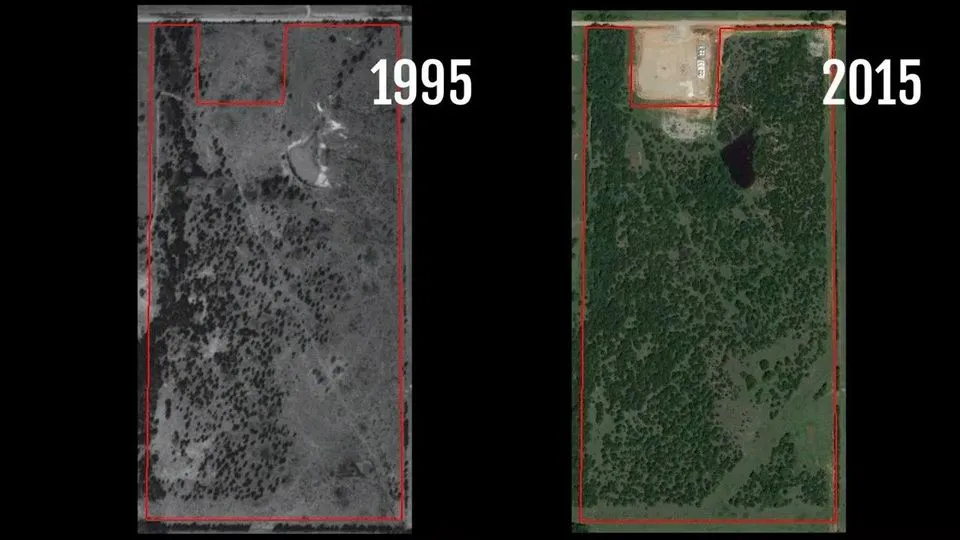
Eastern redcedar is invading prairies from Iowa to Texas due to lack of fire.
Mechanical removal can decrease cedar cover, but it cannot be a one-time treatment.
Watch this video to see an Oklahoma pasture become invaded, cleared and then quickly re-invaded
Tree Cover
1894: 4%
1990: 17%
1993: 9% (after mechanical removal)
2000: 25%
2019: 59%
https://youtu.be/vdX2EXNyPi4?si=-SjwVaptruEaSNy2
See tree cover for your pasture on the Rangeland Analysis Platform [https://rangelands.app](https://rangelands.app)
.webp)
Woody Encroachment
Eastern Redcedar Removal Effect on Runoff & Sediment
RUNOFF
Restored Prairie had higher runoff. This runoff feeds streams & ponds.
2015 - 36 inches of rain
Watershed 1 (juniper/cedar woodlands): Runoff = 1 inch
Watershed 2 (juniper/cedar woodlands): Runoff = 1 inch
2018/2019 - 46 inches of rain (averaged)
Watershed 1 (juniper/cedar woodlands): Runoff = 6 inches
Watershed 2 (restored prairie): Runoff = 11 inches
SEDIMENT LOAD
Juniper/cedar woodland had greater sediment load. Sediment is soil that is eroded and deposited in streams/ponds and decreases water quality.
2015 - 36 inches of rain
Watershed 1 (juniper/cedar woodlands): Sediment Load = 89 lbs/ac/yr
Watershed 2 (juniper/cedar woodlands): Sediment Load= 89 lbs/ac/yr
2018/2019 - 46 inches of rain (averaged)
Watershed 1 (juniper/cedar woodlands): Sediment Load = 651 lbs/ac/yr
Watershed 2 (restored prairie): Sediment Load = 393 lbs/ac/yr
Juniper Woodland
Restored Prairie
Check out the article here https://doi.org/10.1016/j.catena.2021.105816
Zhong et al. 2020 Response of sediment concentration and load to removal of juniper woodland and subsequent establishment of grasslands – A paired experimental watershed study
.webp)
Woody Encroachment
Individual tree ignition is a technique that can kill eastern redcedar or ashe/blueberry juniper trees that have been partially scorched (browned out) after prescribed fire or wildfire.
If only the lower branches of large trees are scorched after the first fire, the tree will not die and individual ignition is needed.
Do this as soon as possible following the initial fire before surrounding fuel has regrown.
To learn how to apply this technique, check out the fact sheet! [https://bit.ly/OSU_Single_Tree_Ig](https://bit.ly/OSU_Single_Tree_Ig)
.webp)
Woody Encroachment
How Does Eastern Redcedar Spread?
Stopping Eastern Redcedar Invasion
.webp)
Woody Encroachment
Eastern Redcedar Seeds are Spread by Birds
Berry (cone) Dispersal by Birds
Germination
Seed Germination
What Can You Do?
Data: The avian seed dispersal system of the eastern red cedar (Juniperus virginana)
https://doi.org/10.1139/b85-208
.webp)
Woody Encroachment
Eastern Redcedar, Ticks, & Disease?
Click to read! https://doi.org/10.52707/1081-1710-46.1.12
This research was done by the Noden Lab in the OSU Plant Pathology Department in conjunction with the OSU Natural Resources Ecology and Management Department.
Continued in-depth research funded by the National Institutes of Health.
Preliminary Results! More research upcoming.
TICK NUMBERS
More lonestar ticks are found in cedar woodlands.
TICK-BORNE PATHOGENS
Oklahoma State University Department of Entomology & Plant Pathology
National Institutes of Health (NIH)
Oklahoma State University Natural Resources Extension
.webp)
Woody Encroachment
Eastern Redcedar Tree Cover Change Over 35 Years 1950-1985*
*(correction: visual previously showed 1980)
140% Increase Statewide
1.5 million acres to 3.5 million acres
Panhandle: 2,000 acres (1985)
Northwest: 652% INCREASE from 92,750 acres to 697,350 acres
North Central: 440% INCREASE from 124,240 acres to 671,031 acres
Northeast: 8% DECREASE from 233,150 acres to 214,185 acres
Central: 321% INCREASE from 88,637 acres to 373,413 acres
East Central: 111% INCREASE from 85,330 acres to 179,854 acres
Southwest: 187% INCREASE from 15,880 acres to 45,617 acres
Southwest-West Central: 23% INCREASE from 47,290 acres to 58,312 acres
Southeast-East Central: 52% INCREASE from 590,600 acres to 900,023 acres
Southeast: 119% INCREASE from 184,200 acres to 403,790 acres
See CURRENT tree cover at [https://rangelands.app/](https://rangelands.app/)
.webp)
Woody Encroachment
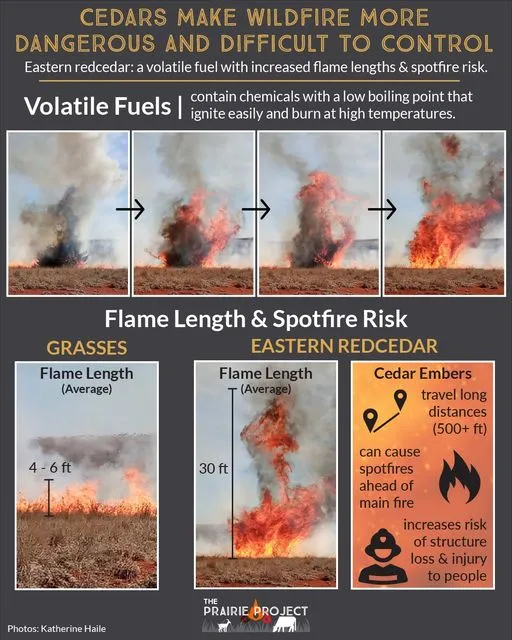
Eastern redcedar is a volatile fuel.
Before wildfire season, remove cedars near structures, on fence lines and in pastures to limit negative wildfire impacts.
The Prairie Project
Woody Encroachment
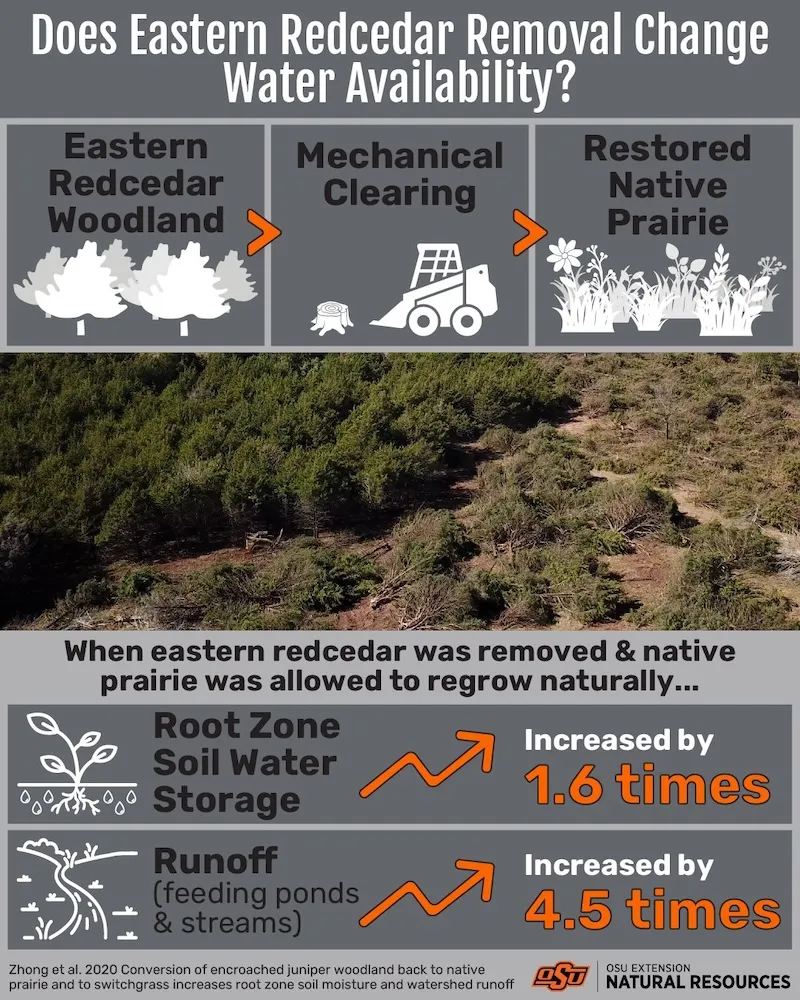
Does eastern redcedar removal change water availability?
In an 8-year study, OSU researchers found that both soil water storage and runoff increased after they mechanically removed eastern redcedar in central Oklahoma and let prairie regenerate naturally.
Soil water storage increased by 1.6 times, providing more water for grasses and broadleaf plants.
Runoff increased by 4.5 times, providing for streams and ponds that are important for people, livestock and wildlife.
Click to read more [http://bit.ly/Zhong_et_al_2020](http://bit.ly/Zhong_et_al_2020)
.webp)
Woody Encroachment
Eastern redcedar removal options include fire, mechanical, chemical and biological.
Look at our most recent posts in case you missed any!
How to manage: Biological
Targeted Grazing: Using specific livestock types in a particular season, for a chosen length of time and intensity, to target certain vegetation types for management goals.
Eastern Redcedar Control
Who: Mature goats
What: 3-6 ft trees
When: Winter
How: Stripping needles and bark
Results: goat control of junipers (relative of eastern redcedar). 52 years of data.
No Goats: 207 trees (0 to <1.6ft), 129 trees (1.6 - 6.5ft), 330 trees (> 6.5ft) for a total of 666
Light Goats: 137 trees (0 to <1.6ft), 72 trees (1.6 - 6.5ft), 145 trees (> 6.5ft) for a total of 354
Heavy Goats: 67 trees (0 to <1.6ft), 22 trees (1.6 - 6.5ft), 34 trees (> 6.5ft) for a total of 123
Cedars are preferred browse of goats in winter.
To read more about goat targeted grazing, click the link! https://bit.ly/GoatTargetedGrazing
The Prairie Project
.webp)
Woody Encroachment
Eastern redcedar removal options include fire, mechanical, chemical and biological.
Stay tuned to learn about all four!
How to manage: CHEMICAL
Individual plant treatments, NOT labeled for broadcast application
Soil Applied: Liquid
Hexazinone, Trade Name: Velpar L, Rate: 2-4ml/inch stem diameter
Picloram, Trade Name: Tordon 22K, Rate: 3-4ml/inch stem diameter
Recommendations:
Soil Applied: Pellets
Hexazinone, Trade Name: Pronone Power Pellets, Rate: 1-2 pellets/inch stem diameter
Recommendations:
Foliar
Picloram, Trade Name: Tordon 22K, Mix Recipe: 4qts/100gal, Tree Height: <12ft
Picloram+fluroxypyr, Trade Name: Surmount, Mix Recipe:1-2 gal/100 gal + 1-2 qts
surfactant, Tree Height:<3ft
Recommendations:
Click to see how management types compare https://bit.ly/ERCBestManagementOSU
The Prairie Project
.webp)
Woody Encroachment
Eastern redcedar removal options include fire, mechanical, chemical and biological.
Stay tuned to learn about all four!
How to manage: FIRE
Small tree control = less risk, cost, & time.
Small trees: <6ft
Burn every 3-5 years to prevent seedling establishment.
Normal burn conditions & adequate fuels can control small trees.
(Temp: >32F, Humidity:30-50%, Wind:10-15mph, Fuel:2000lbs/ac)
Medium trees: 6ft-20ft
Burn every 3-5 years plus….
Ignite remaining trees after fire. Remove skeletons mechanically.
Cut-and-stuff method increases fuels, making fire more effective.
Greater fire intensity and higher fuel loads are more effective.
Large trees: >20ft
Fire is less effective. Mechanical controls recommended.
Click for single tree ignition https://bit.ly/IndvScorchedCedarOSU
Click for cut-and-stuff methods https://bit.ly/CutStuffCedarOSU
The Prairie Project
.webp)
Woody Encroachment
Eastern redcedar removal options include fire, mechanical, chemical and biological.
Stay tuned to learn about all four!
How to manage: MECHANICAL
Follow with fire every 3-5 years or mechanical must be repeated.
Hand Cutting: Chainsaw, loppers
Cut below lowest green branch.
Target females & small trees first.
Use on steep or rocky terrain.
Small acreages or few trees/acre.
Tree Shears & Saws: Skid-steer, tractor attachments
Cut below lowest green branch.
Rubber tires = less soil disturbance.
Trees are easier to cut after fire.
Mulchers & Shredders: Skid-steer, tractor, backhoe
No remaining skeletons.
Rubber tires = less soil disturbance.
Chaining: Two dozers with a chain between
Cost effective on a largescaleUse on steep or rocky terrain.
Large acreages or many trees/acre.
Click for more https://bit.ly/ERCBestManagementOSU
The Prairie Project
.webp)
Woody Encroachment
Eastern Redcedar Invasion into Prairies. Stop the Spread!
The first targets should be adult females and small trees.
Each female tree produces thousands of seeds.
Adult females are blue-green from a distance due to berry-like cones that are blue.
Adult males are brown from a distance due to the small and scaly cones.
Trees can produce seeds at 6 years old, control before they start.
A pasture in 2014 had scattered small trees. Within 5 years, the 2019 image shows visible cedar cover.
Click the link to learn more https://bit.ly/CedarInvasionOSU
The Prairie Project

Prescribed Fire & Patch Burn Grazing
Fire Increases Forage Quality
Patch burning native grassland provides both forage quality AND quantity for livestock and wildlife.
Forage Samples (October 2020)
Previous Burn: Spring (March 2019)
- Time since fire: 19 months
- Crude Protein: 4%
- Total Digestible Nutrients (TDN): 50%
- Forage Production: 4,435 lbs/ac [QUANTITY]
Recent Burn: Summer (August 2020)
- Time since fire: 2 months
- Crude Protein: 11% [QUALITY]
- Total Digestible Nutrients (TDN): 55%
- Forage Production: 350 lbs/ac
Stocking rates were calculated for grazing across the entire pasture.

Prescribed Fire & Patch Burn Grazing
Fire was Frequent in the Great Plains Before 1850
Estimated Fire Frequency (Years Between Repeated Fires) shown on the map.
Data for Fire Frequency Model
- Weather & Climate Data
- Fuel Physical Chemistry
- Tree Ring Fires Scars (170 sites)
- Charcoal Deposits
Map from Guyette et al. 2012 Predicting Fire Frequency with Chemistry and Climate
.webp)
Multi-Species Grazing
Fire + Goats = Redberry Juniper Suppression
Fire makes redberry juniper resprouts…
1. More palatable: lower feeding deterrent chemicals (monoterpenes)
2. Shorter: more accessible to goats
Monoterpene concentrations
Maximize suppression by grazing goats when new juniper growth appears.
Data from Monoterpene production in redberry juniper foliage following fire (2007).
https://doi.org/10.2111/04-160R2.1
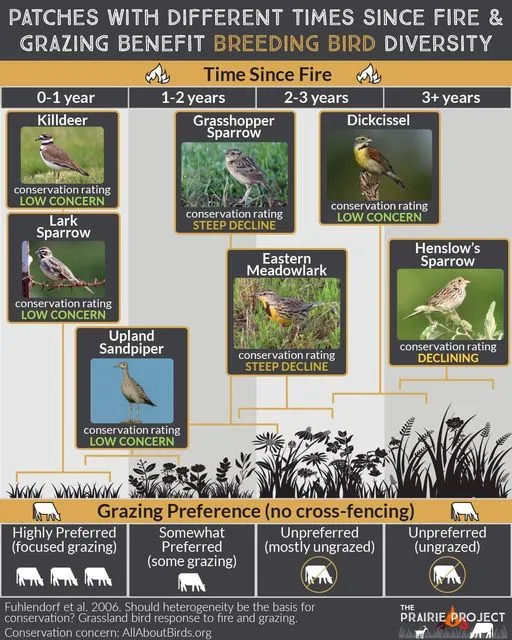
Prescribed Fire & Patch Burn Grazing
Patches with different times since fire & grazing benefit BREEDING BIRD diversity!
Having all in one pasture can provide habitat for more species.
From Fuhlendorf et al. 2006. Should heterogeneity be the basis for conservation? Grassland bird response to fire and grazing. https://doi.org/.../1051-0761(2006)016[1706:SHBTBF]2.0.CO;2
Killdeer
Conservation Rating: Low concern
- Time Since Fire: 0-1 year
- Grazing Preference (no cross fencing): Highly preferred (focused grazing)
Lark Sparrow
- Conservation Rating: Low concern
- Time Since Fire: 0-1 year
- Grazing Preference (no cross fencing): Highly preferred (focused grazing)
Upland Sandpiper
- Conservation Rating: Low concern
- Time Since Fire: 0-1 AND 1-2 years
- Grazing Preference (no cross fencing): Highly preferred (focused grazing) AND Somewhat preferred (some grazing)
Grasshopper Sparrow
- Conservation Rating: Steep decline
- Time Since Fire: 1-2 AND 2-3 years
- Grazing Preference (no cross fencing): Somewhat preferred (some grazing) AND Unpreferred (mostly ungrazed)
Eastern Meadowlark
- Conservation Rating: Steep decline
- Time Since Fire: 1-2 AND 2-3 years
- Grazing Preference (no cross fencing): Somewhat preferred (some grazing) AND Unpreferred (mostly ungrazed)
Dickcissel
- Conservation Rating: Low concern
- Time Since Fire: 2-3 AND 3+ years
- Grazing Preference (no cross fencing): Unpreferred (mostly ungrazed) AND Unpreferred (ungrazed)
Henslow's Sparrow
- Conservation Rating: Declining
- Time Since Fire: 3+ years
- Grazing Preference (no cross fencing): Unpreferred (ungrazed)
Conservation Concern: https://www.allaboutbirds.org/guide/
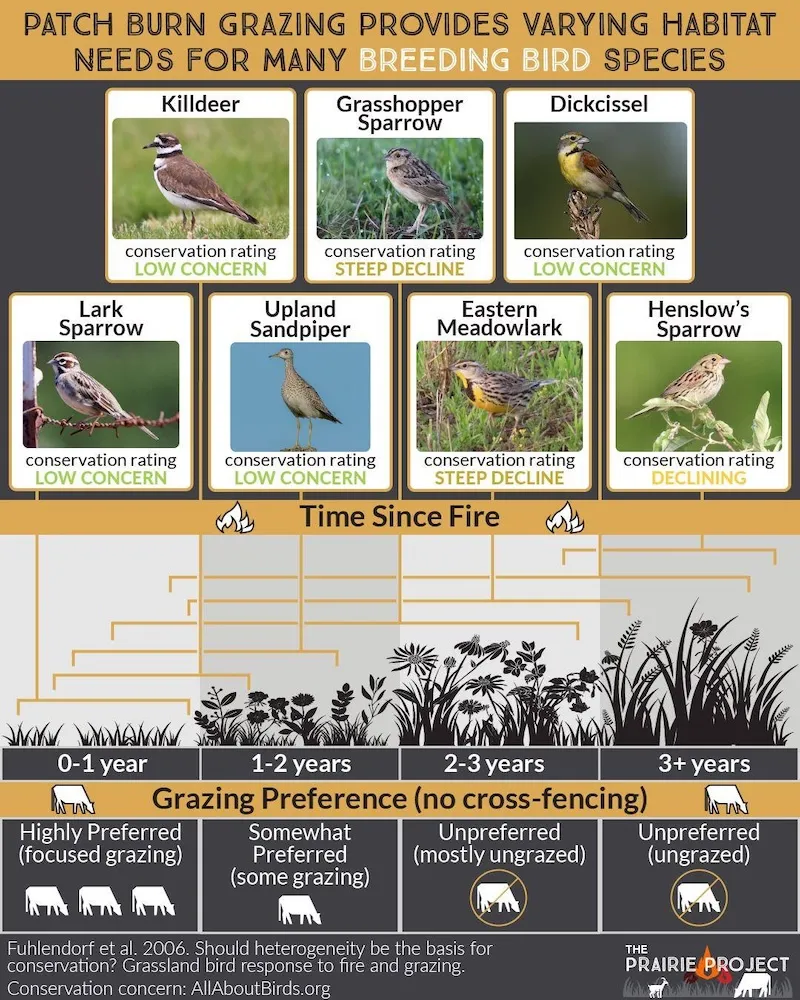
Wildlife Management
Patch Burn Grazing Provides Varying Habitat Needs for Many BREEDING BIRD Species
Having all in one pasture can provide habitat for more species.
From Fuhlendorf et al. 2006. Should heterogeneity be the basis for conservation? Grassland bird response to fire and grazing. https://pubmed.ncbi.nlm.nih.gov/17069365/
Killdeer
Conservation Rating: Low concern
- Time Since Fire: 0-1 year
- Grazing Preference (no cross fencing): Highly preferred (focused grazing)
Lark Sparrow
- Conservation Rating: Low concern
- Time Since Fire: 0-1 year
- Grazing Preference (no cross fencing): Highly preferred (focused grazing)
Upland Sandpiper
- Conservation Rating: Low concern
- Time Since Fire: 0-1 AND 1-2 years
- Grazing Preference (no cross fencing): Highly preferred (focused grazing) AND Somewhat preferred (some grazing)
Grasshopper Sparrow
- Conservation Rating: Steep decline
- Time Since Fire: 1-2 AND 2-3 years
- Grazing Preference (no cross fencing): Somewhat preferred (some grazing) AND Unpreferred (mostly ungrazed)
Eastern Meadowlark
- Conservation Rating: Steep decline
- Time Since Fire: 1-2 AND 2-3 years
- Grazing Preference (no cross fencing): Somewhat preferred (some grazing) AND Unpreferred (mostly ungrazed)
Dickcissel
- Conservation Rating: Low concern
- Time Since Fire: 1-2, 2-3 AND 3+ years
- Grazing Preference (no cross fencing): Unpreferred (mostly ungrazed) AND Unpreferred (ungrazed)
Henslow's Sparrow
- Conservation Rating: Declining
- Time Since Fire: 3+ years
- Grazing Preference (no cross fencing): Unpreferred (ungrazed)
Conservation Concern: https://www.allaboutbirds.org/
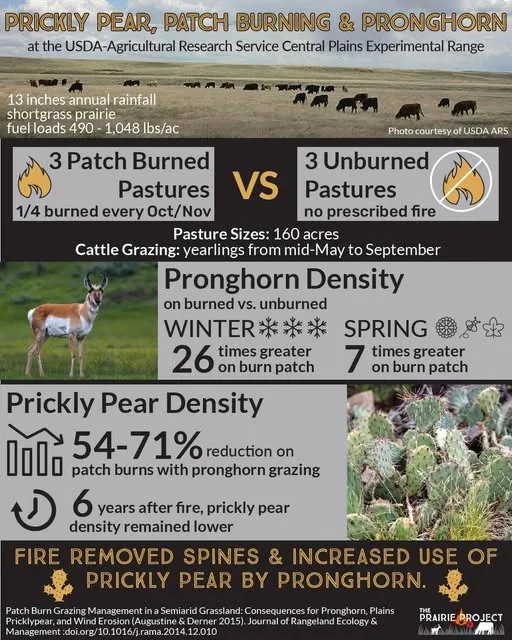
Wildlife Management
Prickly Pear, Patch Burning & Pronghorn
at the USDA Agricultural Research Service Central Plains Experimental Range
- 13 inches annual rainfall
- shortgrass prairie
- fuel loads 490-1,048 lbs/ac
Pasture Sizes: 160 acres
Cattle Grazing: yearlings from mid-May to September
PRONGHORN DENSITY on burned vs unburned
- Winter: 26 times greater on burn patch
- Spring: 7 times greater on burn patch
PRICKLY PEAR DENSITY
- 54-71% reduction on patch burns with pronghorn grazing
- 6 years after fire, prickly pear density remained lower
Fire Removed Spines & Increased Use of Prickly Pear by Pronghorns
Data from Patch Burn Grazing Management in a Semiarid Grassland: Consequences for Pronghorn, Plains Pricklypear, and Wind Erosion (Augustine & Derner, 2015) https://doi.org/10.1016/j.rama.2014.12.010
.webp)
Prescribed Fire & Patch Burn Grazing
Prickly Pear, Patch Burning & Pronghorn
at the USDA Agricultural Research Service Central Plains Experimental Range
- 13 inches annual rainfall
- shortgrass prairie
- fuel loads 490-1,048 lbs/ac
Pasture Sizes: 160 acres
Cattle Grazing: yearlings from mid-May to September
PRONGHORN DENSITY on burned vs unburned
- Winter: 26 times greater on burn patch
- Spring: 7 times greater on burn patch
PRICKLY PEAR DENSITY
- 54-71% reduction on patch burns with pronghorn grazing
- 6 years after fire, prickly pear density remained lower
Fire Removed Spines & Increased Use of Prickly Pear by Pronghorns
Data from Patch Burn Grazing Management in a Semiarid Grassland: Consequences for Pronghorn, Plains Pricklypear, and Wind Erosion (Augustine & Derner, 2015) [https://doi.org/10.1016/j.rama.2014.12.010](https://doi.org/10.1016/j.rama.2014.12.010)
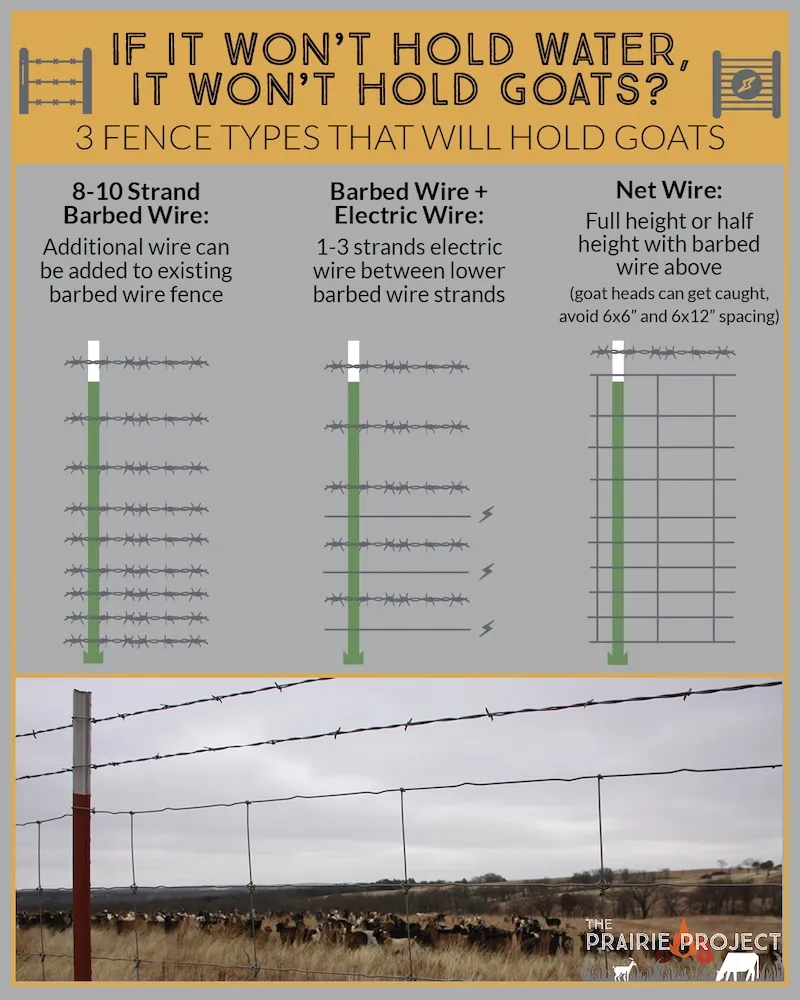
Multi-Species Grazing
Have you heard the phrase "If it won't hold water, it won't hold goats"?
Here are 3 fence types that will hold goats