
Multi-Species Grazing
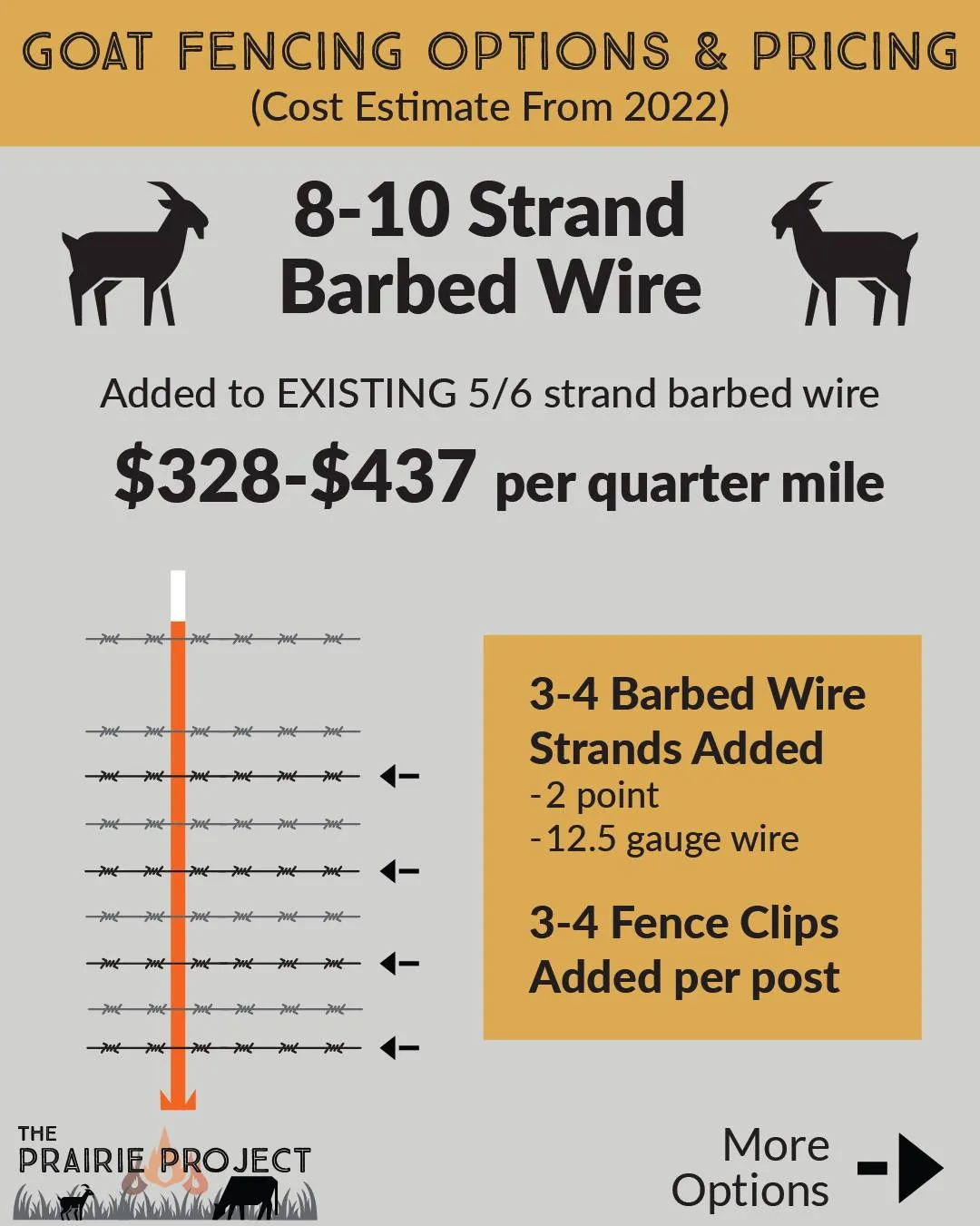
8-10 Strand Barbed Wire
(added to EXISTING 5/6 strand barbed wire)
$328-$437 per quarter mile
- 3-4 Barbed wire strands added
- 2 point
- 12.5 gauge wire
- 3-4 Fence Clips Added per Post

Multi-Species Grazing
Barbed Wire + Electric Wire
(added to EXISTING 5/6 strand barbed wire)
$110* per quarter mile
- 2 Galvanized Wire Strands Added
- 14 gauge electric wire
- 2 Insulators Added per Post
- snug fit
*cost of charger not included
Multi-Species Grazing
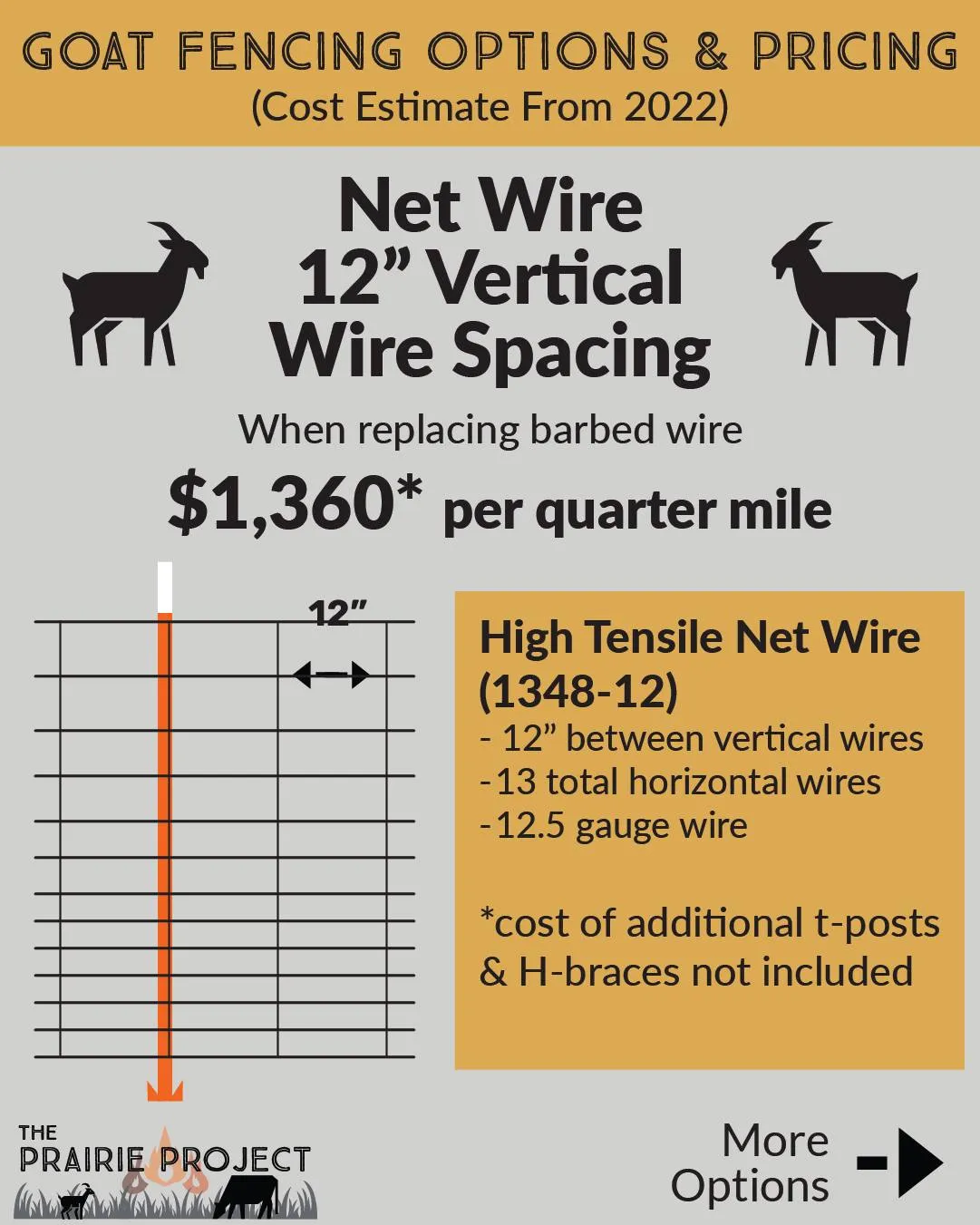
Net Wire 12" Vertical Wire Spacing
(when replacing barbed wire)
$1,360* per quarter mile
- High Tensile Net Wire (1348-12)
- 12" between vertical wires
- 13 total horizontal wires
- 12.5 gauge wire
*cost of additional t-posts & H-braces not included
Multi-Species Grazing
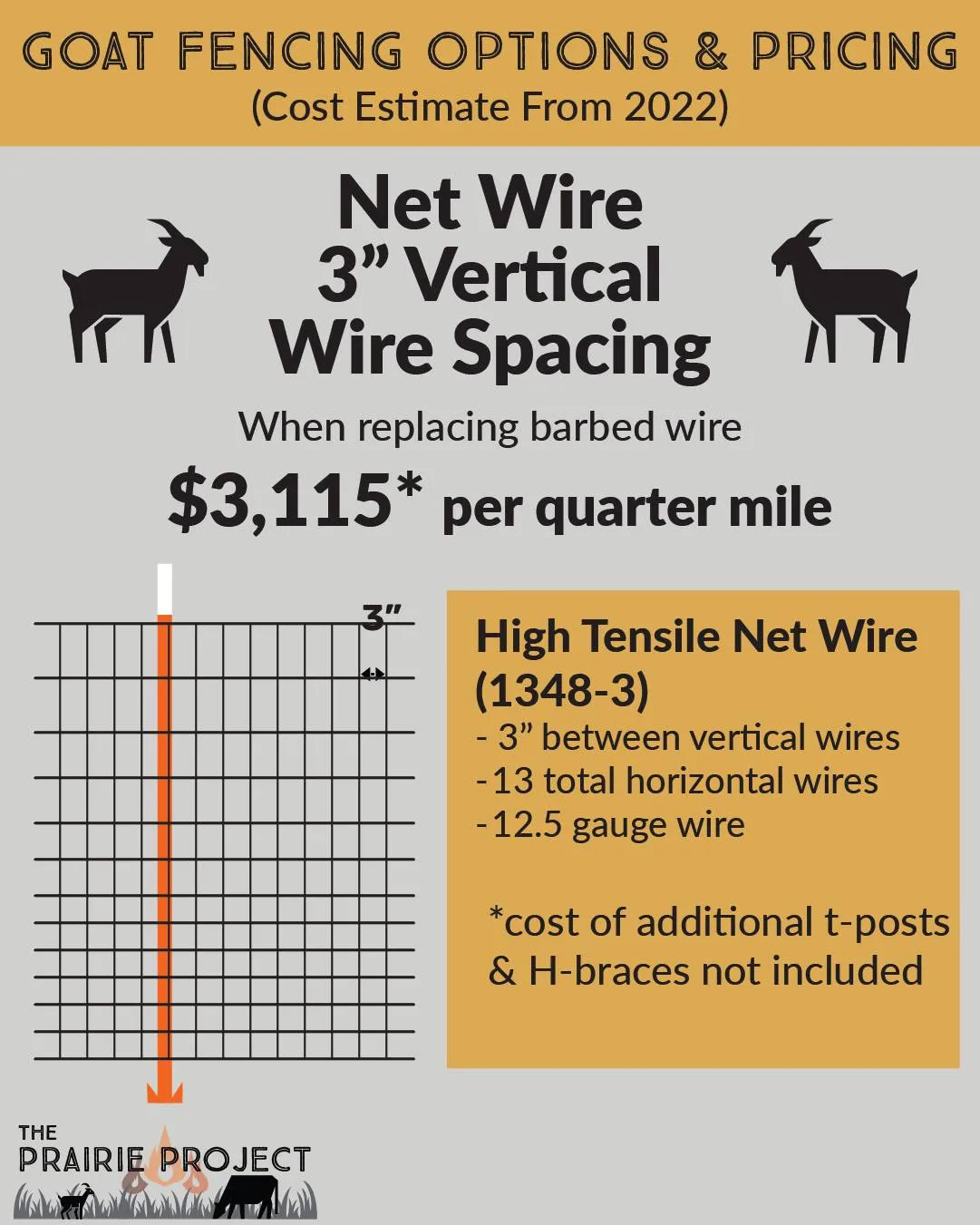
Net Wire 3" Vertical Wire Spacing
(when replacing barbed wire)
$3,115* per quarter mile
- High Tensile Net Wire (1348-3)
- 3" between vertical wires
- 13 total horizontal wires
- 12.5 gauge wire
*cost of additional t-posts & H-braces not included
Multi-Species Grazing
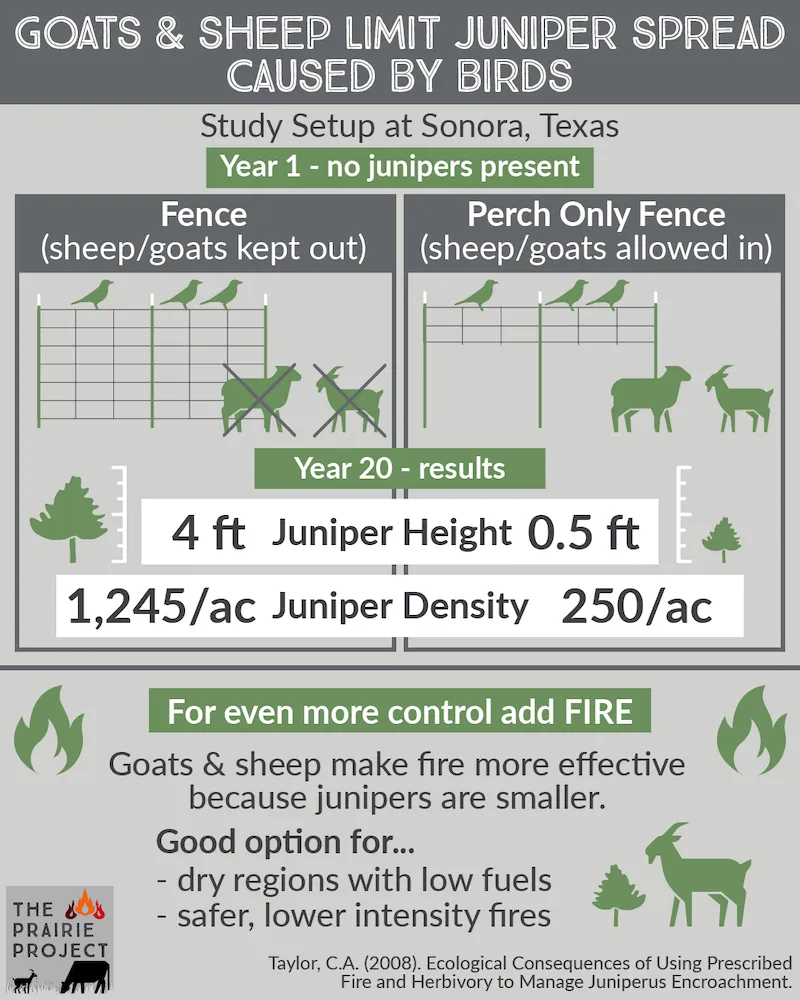
Goats & Sheep Limit Juniper Spread Caused by Birds
Study Setup at Sonora, Texas
Year 1 - no junipers present
Year 20 - results
Juniper Height:
Juniper Density:
For even more control add FIRE
Goats & sheep make fire more effective because junipers are smaller.
Good option for...
https://link.springer.com/.../10.1007/978-0-387-34003-6_13
Woody Encroachment
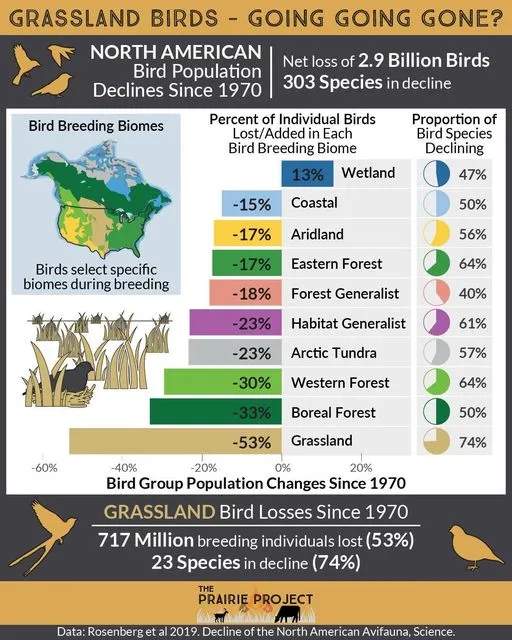
Grassland Birds - Going Going Gone?
Learn about protecting and managing grasslands here! https://www.theprairieproject.org/
North American Bird Population Declines Since 1970
Grassland Bird Losses since 1970
Bird Group Populations Changes since 1970
Percent of individual birds lost/added
Percent of Bird Species Declining
Breeding Bird Biome Groups - Birds select specific biomes during breeding
Data: Rosenberg et al 2019. Decline of the North American Avifauna, Science.
https://www.science.org/doi/10.1126/science.aaw1313
Science
Wildlife Management
Grassland Birds - Going Going Gone?
Learn about protecting and managing grasslands here! https://www.theprairieproject.org/
North American Bird Population Declines Since 1970
- Net loss of 2.9 Billion birds
- 303 Species in decline
Grassland Bird Losses since 1970
- 717 Million breeding individuals lost (53%)
- 23 Species in decline (74%)
Bird Group Populations Changes since 1970
Percent of individual birds lost/added
- Wetland: 13% added
- Coastal: 15% lost
- Aridland: 17% lost
- Eastern Forest: 17% lost
- Forest Generalist: 18% lost
- Habitat Generalist: 23% lost
- Artic Tundra: 23% lost
- Western Forest: 30% lost
- Boreal Forest: 33% lost
- Grassland: 53% lost
Percent of Bird Species Declining
- Wetland: 47%
- Coastal: 50%
- Aridland: 56%
- Eastern Forest: 64%
- Forest Generalist: 40%
- Habitat Generalist: 61%
- Artic Tundra: 57%
- Western Forest: 64%
- Boreal Forest: 50%
- Grassland: 74%
Breeding Bird Biome Groups - Birds select specific biomes during breeding
Data: Rosenberg et al 2019. Decline of the North American Avifauna, Science.
https://www.science.org/doi/10.11

Woody Encroachment
Grasslands are the most threatened terrestrial ecosystems worldwide.
See the regional losses and the worldwide ranking of Great Plains grasslands from Scholtz & Twidwell 2022 https://doi.org/10.1111/csp2.626

Woody Encroachment
Grasslands are the most threatened terrestrial ecosystems worldwide.
See the regional losses and the worldwide ranking of Great Plains grasslands from Scholtz & Twidwell 2022 https://doi.org/10.1111/csp2.626
Prescribed Fire & Patch Burn Grazing
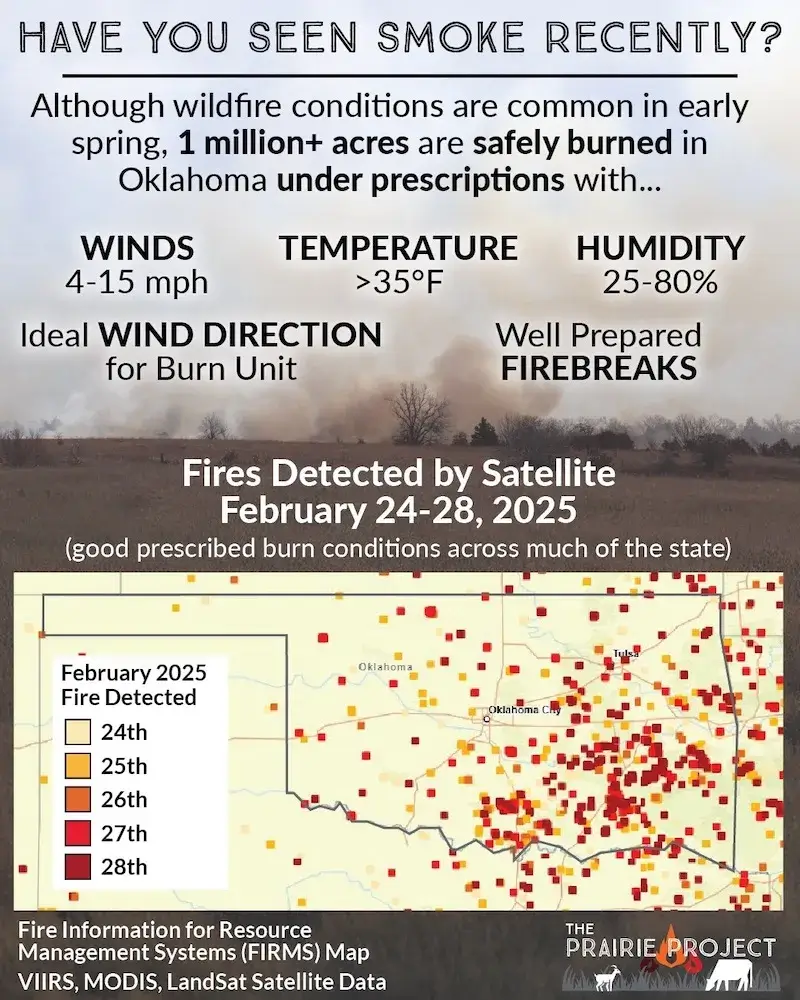
Have You Seen Smoke Recently?
Although wildfire conditions are common in early spring, 1 million+ acres are safely burned in Oklahoma under prescriptions with...
- WINDS 4-15mph
- TEMPERATURE >35°F
- HUMIDITY 25-80%
- Ideal WIND DIRECTION for Burn Unit
- Well Prepared FIREBREAKS
Fires Detected By Satellite February 24-28, 2025
(good prescribed burn conditions across much of the state)
Fire Information for Resources Management Systems (FIRMS) Map
From VIIRS, MODIS, & LandSat Satellite Data https://go.nasa.gov/4ixGIxw
For more, check out the Fire Prescriptions factsheet! https://bit.ly/OSUFirePrescriptionsFactsheet
Woody Encroachment
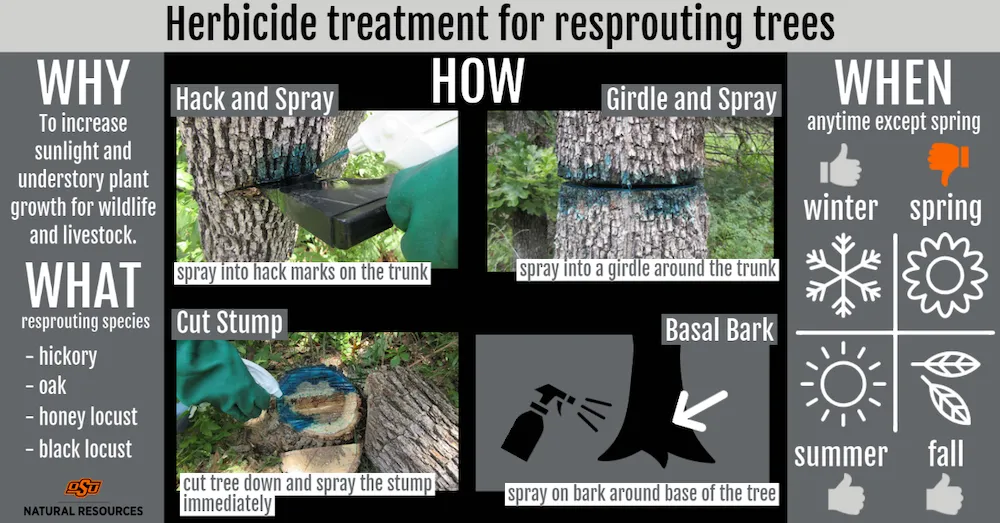
Herbicide application techniques are effective for thinning forests of resprouting tree species. This increases sunlight and understory plant growth for wildlife and livestock.
.webp)
Prescribed Fire & Patch Burn Grazing
Historic Fire Return Intervals
Kansas & Nebraska
Data from tree ring fire scarring
The Lazy S-B Ranch, Kansas
1765-1849: 2.7 average years between fires
Scotts Bluff National Monument, Nebraska
Prior to 1932: 15-30 average years between fires
Northern Nebraska Sandhills Prairie, Nebraska
1850-1900: 4-5 average years between fires
The Lazy S-B Ranch: Guyette Richard P. et al 2015 (http://dx.doi.org/10.1353/gpr.2015.0031)
Scotts Bluff National Monument: Wendtland & Dodd 1990 (https://npshistory.com/publications/scbl/fire-history.pdf)
Northern Nebraska Sandhills Prairie: Bragg 1991 ([https://www.frames.gov/catalog/33748](https://www.frames.gov/catalog/33748))
.webp)
Prescribed Fire & Patch Burn Grazing
Historic Fire Return Intervals - NEW MEXICO & OKLAHOMA
Data from Tree Ring Fire Scars
Capulin Volcano National Park
1751-1890: 12-19 average years between fires
Keystone Ancient Forest Preserve
1772-1830: 5 average years between fires
Nickel Family Nature & Wildlife Preserve
1650-1780: 5 average years between fires
Okmulgee Game Management Area
1750-1836: 6 average years between fires
Capulin Volcano National Park: Guyette et al, 2006 https://www.jstor.org/stable/23780059
Keystone Ancient Forest Preserve: Clark et al 2012 https://bit.ly/Clark_et_al_2012
Nickel Family Nature & Wildlife Preserve: Stambaugh et al 2013 https://doi.org/10.1007/s10745-013-9571-2
Okmulgee Game Management Area: DeSantis 2010 [https://doi.org/10.4996/fireecology.0603045](https://doi.org/10.4996/fireecology.0603045)

Prescribed Fire & Patch Burn Grazing
Historic Fire Return Interval - TEXAS
Data from Tree Ring Fire Scars
Davis Mountain Preserve
1700-200: 11.2 avg years between fires
Purtis Creek State Park
1690-1820: 6.7 avg. years between fires
Bastrop State Park
1653-1829: 10.9 avg. years between fires
Big Bend National Park
1700-2000: 36.5 avg years between fire
Balcones Canyonlands National Wildlife Refuge
1917-2001: 2.2-14 avg. years between fires
Davis Mountains: Poulos, Helen et al., 2009 https://doi.org/10.1139/X09-052
Big Bend National Park: Poulos, Helen, et al., 2009 https://doi.org/10.1139/X09-052
Purtis Creek State Park: Stambaugh, Michael, et al., 2011 https://doi.org/10.2111/REM-D-10-00128.1
Balcones Canyonlands National Wildlife Refuge: Murray, Darrel, et al., 2013 https://doi.org/10.1674/0003-0031-170.2.348
Bastrop State Park: Stambaugh, Michael, et al., 2017 [https://doi.org/10.1016/j.foreco.2017.04.017](https://doi.org/10.1016/j.foreco.2017.04.017)
.webp)
Prescribed Fire & Patch Burn Grazing
Historic Fire Return Intervals
Missouri & Arkansas
Data from Tree Ring Fire Scarring
Brickyard Hill Conservation Area, Missouri
1672-1820: 7 average years between fires
Lower Buffalo Wilderness Area, Arkansas
1680-1880: 2-8 average years between fires
Hot Springs National Park, Arkansas
1711-1960: 4-8 average years between fires
Lower Boston Mountains , Arkansas
<1680-1880: 3-11 years between fires
Brickyard Hill Conservation Area: Stambaugh et al 2006 https://www.jstor.org/stable/23780058
Lower Buffalo Wilderness Area: Stambaugh & Guyette 2006 https://doi.org/.../0003-0031(2006)156[237:FROAOW]2.0.CO;2
Hot Springs National Park: Johnson & Schnell 1985
Lower Boston Mountains: Guyette & Spetich 2003 [https://doi.org/10.1016/S0378-1127(02)00613-8](https://doi.org/10.1016/S0378-1127(02)00613-8)

Multi-Species Grazing
Adding goats to cattle herds
Bygone Grazers: Historical Accounts of Lost Browsers & Grazers
Elk - 1804, Dixon County, NE - Lewis and Clark Expedition
"1 elk killed; 2 elk observed swimming across the Missouri River"
Elk - 1806, Smith County, KS - Zebulon Pike
"In about a mile we discovered a herd of elk which we pursued."
Pronghorn - 1806, Lyon & Coffey Counties, KS - Zebulon Pike
"[We] killed one carbie (pronghorn), two deer and two turkeys"
Elk & Pronghorn - 1832, Cimarron River, OK - Washington Irving
"..tracks of... elk, deer, antelope, bears, raccoons, turkey and waterfowl were numerous at the edge of the river."
Bison - 1819, Potato Hills, Latimer County, OK - Thomas Nuttall
"Herds of bison roamed the prairie and bolted as the soldiers gave chase.."
Elk & Bison - 1800, Brazos River, TX - Ellis P. Bean
"..we found elk and deer plenty, some buffalo and wild horses by the thousands."
Elk - 1842, Starr County, TX - William Stapp
"... deer, elk, turkeys and Mexican hogs are found in abundance.."
Read more about multi-species grazing here! https://www.theprairieproject.org/.../solut.../multi-species
Woody Encroachment
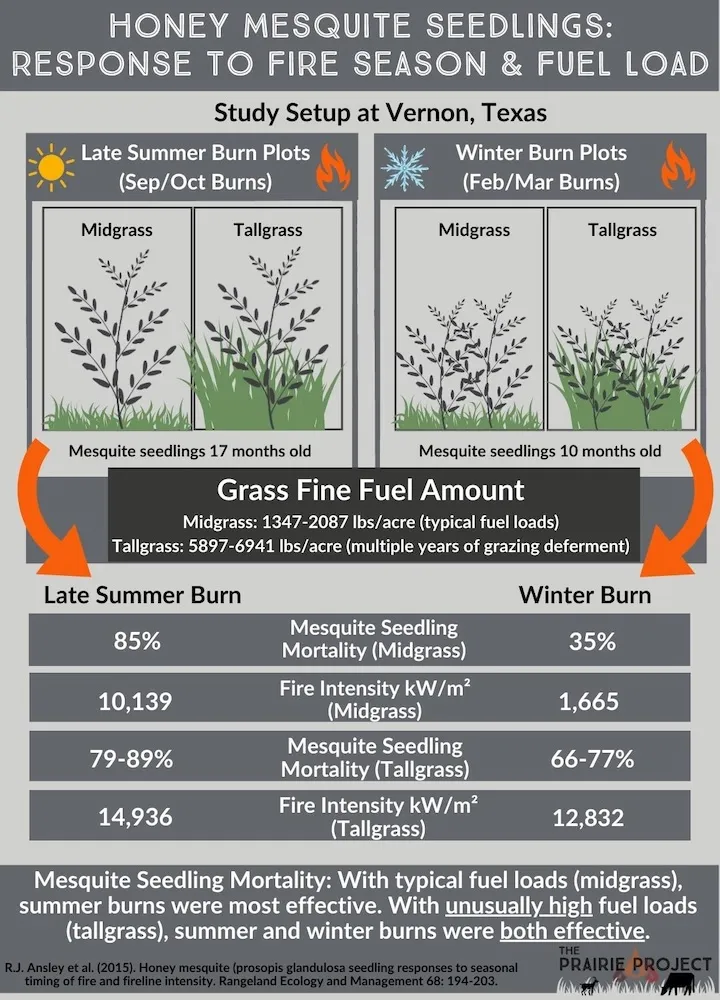
Honey Mesquite Seedlings: Response To Fire Season & Fuel Load
Study Setup at Vernon, TX
Late Summer Burn Plots (Sep/Oct Burns)
Mesquite Seedlings: 17 months old
Grass Fine Fuel Amount: 1347-2087 lbs/acre (typical fuel loads)
Winter Burn Plots (Feb/Mar Burns)
Mesquite Seedlings 10 months old
Grass Fine Fuel Amount: 5897-6941 lbs/acre (multiple years of grazing deferment)
Mesquite Seedling Mortality (Midgrass)
Late Summer Burn: 85%
Winter Burn: 35%
Fire Intensity kW/m² (Midgrass)
Late Summer Burn: 10,139
Winter Burn: 1,665
Mesquite Seedling Mortality (Tallgrass)
Late Summer Burn: 79-89%
Winter Burn: 66-77%
Fire Intensity kW/m² (Tallgrass)
Late Summer Burn: 14,936
Winter Burn: 12,832
Mesquite Seedling Mortality: With typical fuel loads (midgrass), summer burns were most effective. With unusually high fuel loads (tallgrass), summer and winter burns were both effective.
R.J. Ansley et al. Honey mesquite (prosopis glandulosa) seedling responses to seasonal timing of fire and fireline intensity. https://bit.ly/3YHIgLD
University of Arizona Libraries
Society for Range Management
Oklahoma State University Natural Resources Extension
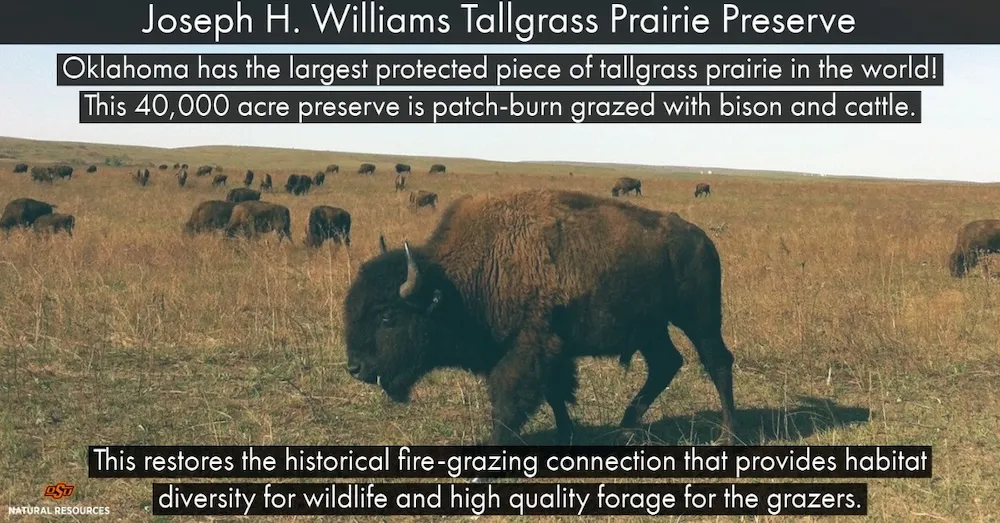
Prescribed Fire & Patch Burn Grazing
Check out this PBS segment on Oklahoma�s own Tallgrass Prairie Preserve! http://bit.ly/TGP_PBS
Tallgrass Prairie Preserve
PBS
.webp)
Woody Encroachment
Woody plants taking over Kansas Rangelands!
The #2 land use in Kansas that makes up 18 million acres is grazed rangelands, pastures, and forests. This land is under threat from woody species that are well adapted to fire and capable of resprouting from the roots after burning. Resprouting species include:
Adding goats and sheep to cattle operations in addition to fire can help limit the spread of these woody species. This is because new plant growth after fire is highly palatable and within reach of goats.
To read more on land use in Kansas you can navigate to: https://www.ers.usda.gov/.../maps-and-state-rankings-of.../
#prescribedfire #brushmanagement #rangelands West Texas Rangelands Oklahoma State University Natural Resources Extension #Kansas Texas A&M AgriLife Sheep and Goat Extension
.webp)
Woody Encroachment
Preserving Nebraska's Rangelands against Woody Plant Encroachment!
Did you know Nebraska's #1 form of land use is Grazing of Rangelands and Pastures? This covers 25 million acres!
Nebraska rangelands #1 threat is Eastern Redcedar which impacts rangelands by:
However, solutions that have been shown to successfully slow the spread of Eastern Redcedar include: Prescribed fire and multi-species grazing
To read more on Nebraska's land-use you can navigate to:
https://www.ers.usda.gov/.../maps-and-state-rankings-of.../
Oklahoma State University Natural Resources Extension West Texas Rangelands The Nature Conservancy #rangelands #prescribedfire #brushremoval Texas A&M AgriLife Extension Service
.webp)
Woody Encroachment
Preserving Prairie in Texas!
Did you know the #1 land use in Texas is grazing of pastures, rangelands, and forest?
These lands are at risk of woody plant encroachment which can decrease important ecosystem services like:
1. Clean air and water
2. Wildlife habitat
3. Forage for livestock
The Prairie Project strives to help preserve and protect our rangelands through rangeland techniques such as prescribed fire and multi-species grazing.
To learn more about land use of Texas rangelands you can navigate to: https://bit.ly/3KYOIXK
#AgriLifeExtension #RxFIRE #brushmanagement #rangelands West Texas Rangelands Oklahoma State University Natural Resources Extension U.S. Department of Agriculture
Prescribed Fire & Patch Burn Grazing
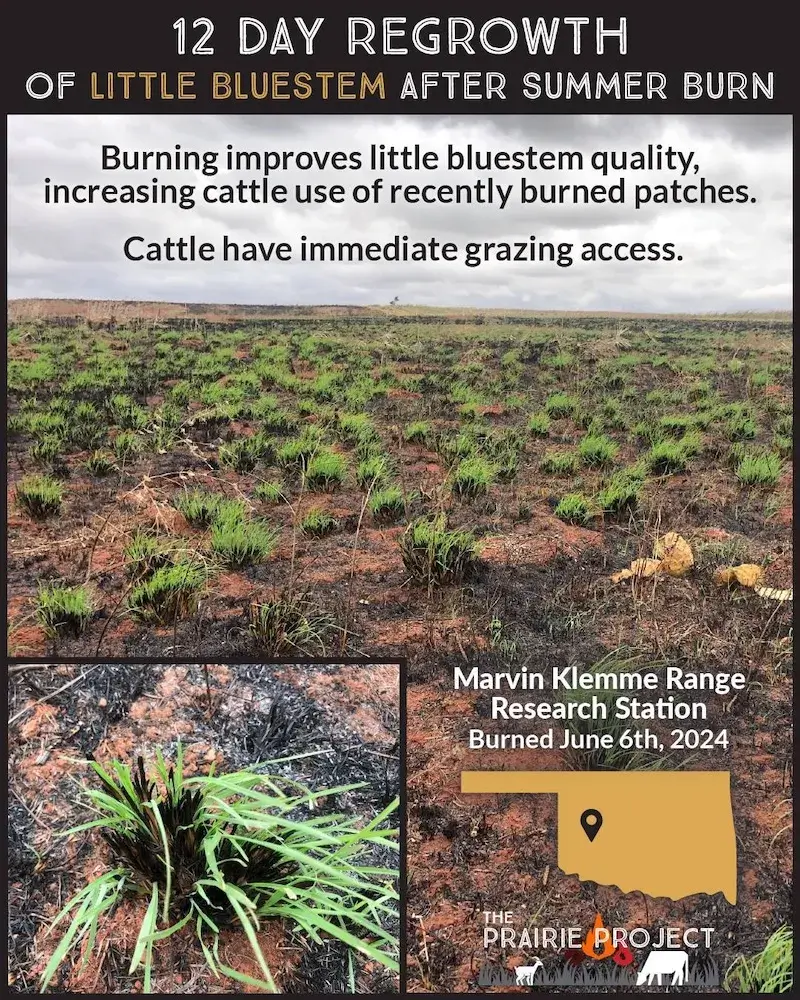
12 Day Regrowth of Little Bluestem After Summer Burn
Burning improves little bluestem quality, increasing cattle use of recently burned patches.
Cattle have immediate access.
Marvin Klemme Range Research Station Burned June 6th, 2024.
Multi-Species Grazing
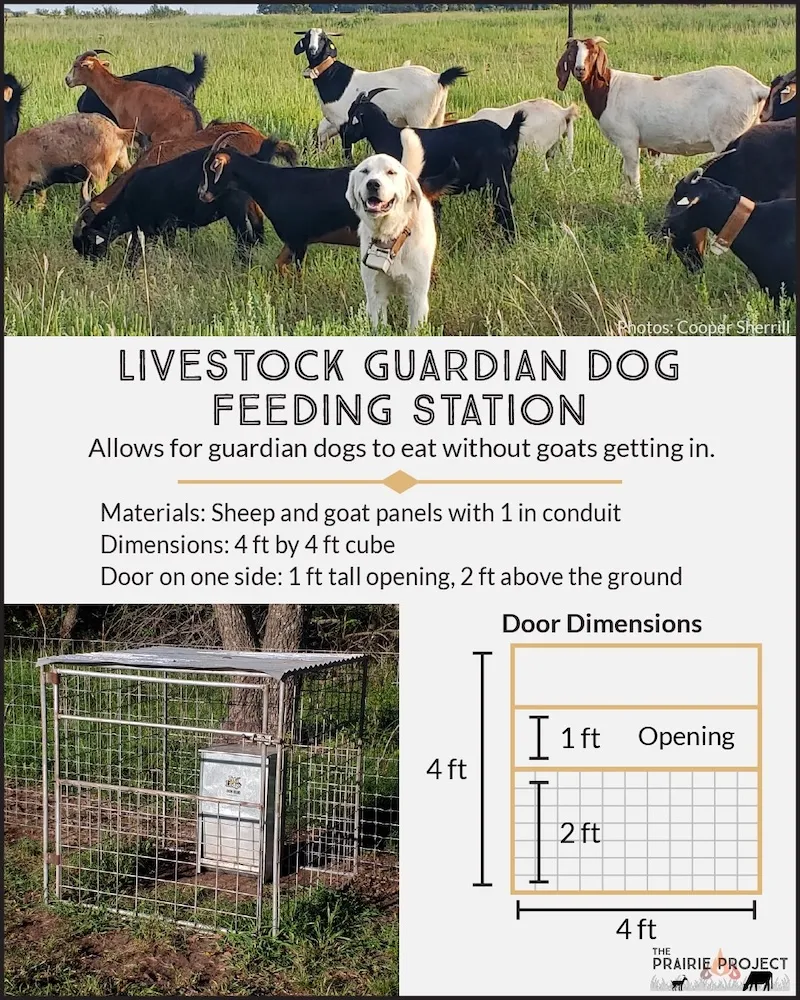
Livestock Guardian Dog Feeding Station.
Our collaborating researchers in Oklahoma are using this Texas Agrilife design for dog feeding stations. This allows for guardian dogs to eat without goats getting in.
Materials: Sheep and goat panels with 1 in conduit
Dimensions: 4 ft by 4 ft cube
Door on one side: 1 ft tall opening, 2 ft above the ground
Texas A&M AgriLife Livestock Guardian Dog Program
Multi-Species Grazing
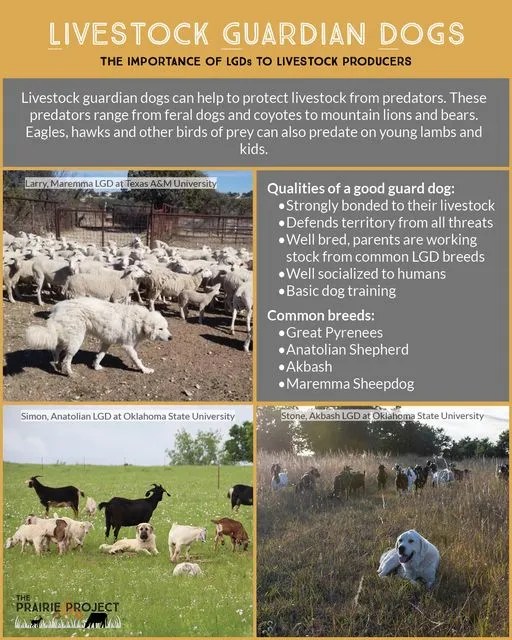
Livestock guardian dogs (LGDs) can help to protect livestock from predators. These predators range from feral dogs and coyotes to mountain lions and bears. Eagles, hawks and other birds of prey can also predate on young lambs and kids.
Qualities of a good guard dog:
Common Breeds:
Texas A&M AgriLife Livestock Guardian Dog Program
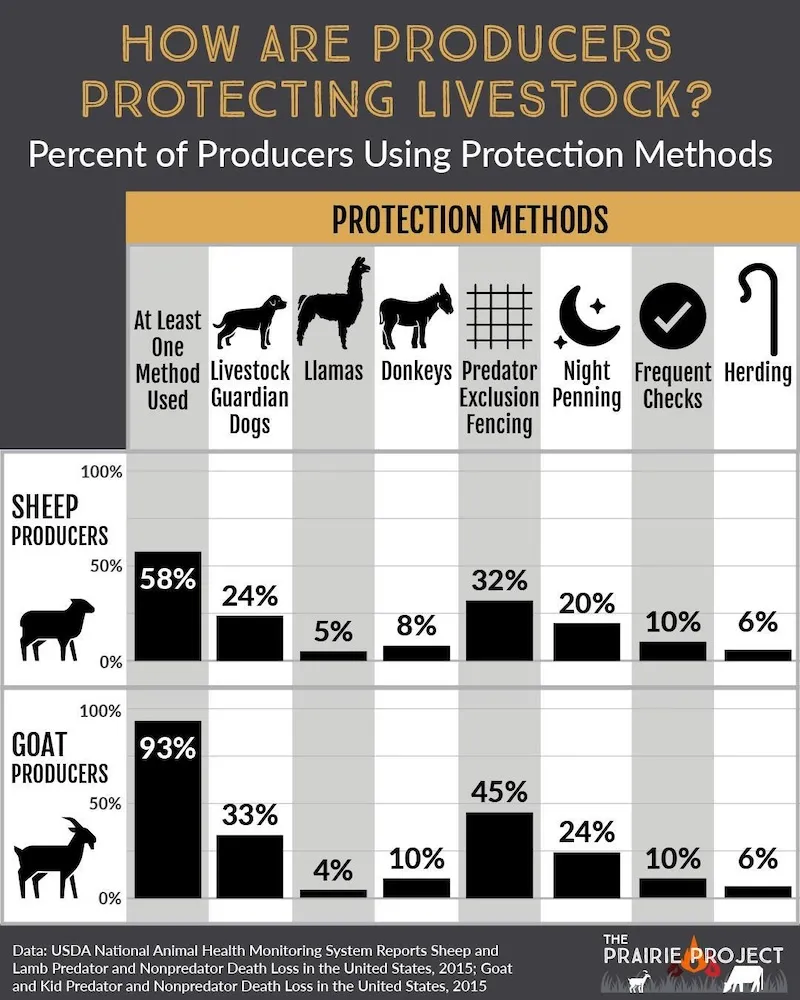
Multi-Species Grazing
How are Producers Protecting Livestock?
Percent of Producers Using Protection Methods
SHEEP PRODUCERS
At Least One Method Used: 58%
Livestock Guardian Dogs: 24%
Llamas: 5%
Donkeys: 8%
Predator Exclusion Fencing: 32%
Night Penning: 20%
Frequent Checks: 10%
Herding: 6%
GOAT PRODUCERS
At Least One Method Used: 93%
Livestock Guardian Dogs: 33%
Llamas: 4%
Donkeys: 10%
Predator Exclusion Fencing: 45%
Night Penning: 24%
Frequent Checks: 10%
Herding: 6%
Data from USDA National Animal Health Monitoring System Reports
https://bit.ly/SheepLossUSDA_NAHMS2015
https://bit.ly/GoatLossUSDA_NAHMS2015