
Woody Encroachment
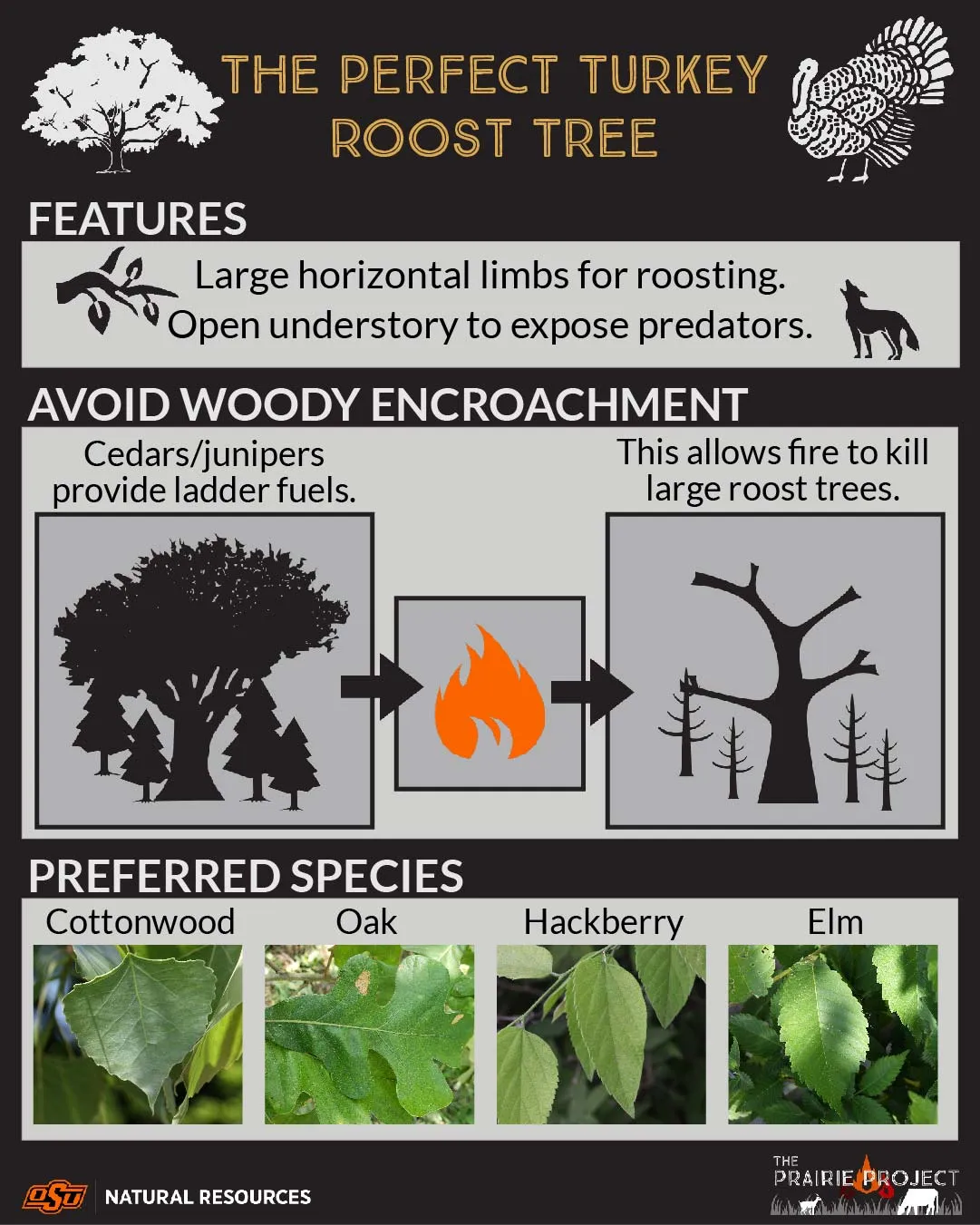
What makes the perfect turkey roost tree?
Features
Large horizontal limbs for roosting.
Open understory to expose predators.
Avoid Woody Encroachment
Cedars/junipers provide ladder fuels.
This allows fire to kill large roost trees.
Preferred Species
To read more about managing habitat for wild turkey, click the link https://bit.ly/TurkeyMgtOSU
.webp)
Woody Encroachment
Tyranny of Trees: History of Tree Planting in Great Plains Grasslands
Part 1: The Timber Culture Act (1873)
160 acres granted to homesteaders
REQUIREMENTS
Photo shows woodlot of locust and white elm trees in the High Plains of Texas.
Source: 1905 Advice for Forest Planters in Oklahoma and Adjacent Regions
Millions of Acres Were Claimed (2 million in Nebraska alone)
For over 150 years, grasslands have been undervalued.
They are still being converted to woodlands & croplands.
What Tree Species? ->
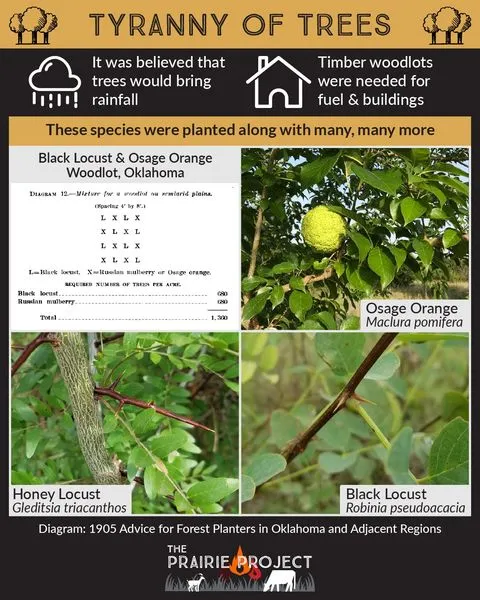
It was believed that trees would bring rainfall.
Timber woodlots were needed for fuel & buildings
These species were planted along with many, many more.
Osage Orange (Maculra pomifera)
Honey Locust (Gleditsia triacanthos)
Black Locust (Robina pseudoacacia)
Black Locust & Osage Orange Woodlot, Oklahoma
Diagram shows alternating species for a "checkerboard" pattern and recommends 1,360 total trees in 1 acre.
Source: 1905 Advice for Forest Planters in Oklahoma and Adjacent Regions
Woody Encroachment
Tyranny of Trees: History of Tree Planting in Great Plains Grasslands
Part 1: The Timber Culture Act (1873)
160 acres granted to homesteaders
REQUIREMENTS
Photo shows woodlot of locust and white elm trees in the High Plains of Texas.
Source: 1905 Advice for Forest Planters in Oklahoma and Adjacent Regions
Millions of Acres Were Claimed (2 million in Nebraska alone)
For over 150 years, grasslands have been undervalued.
They are still being converted to woodlands & croplands.
What Tree Species? ->
It was believed that trees would bring rainfall.
Timber woodlots were needed for fuel & buildings
These species were planted along with many, many more.
Osage Orange (Maculra pomifera)
Honey Locust (Gleditsia triacanthos)
Black Locust (Robina pseudoacacia)
Black Locust & Osage Orange Woodlot, Oklahoma
Diagram shows alternating species for a "checkerboard" pattern and recommends 1,360 total trees in 1 acre.
Source: 1905 Advice for Forest Planters in Oklahoma and Adjacent Regions
Woody Encroachment
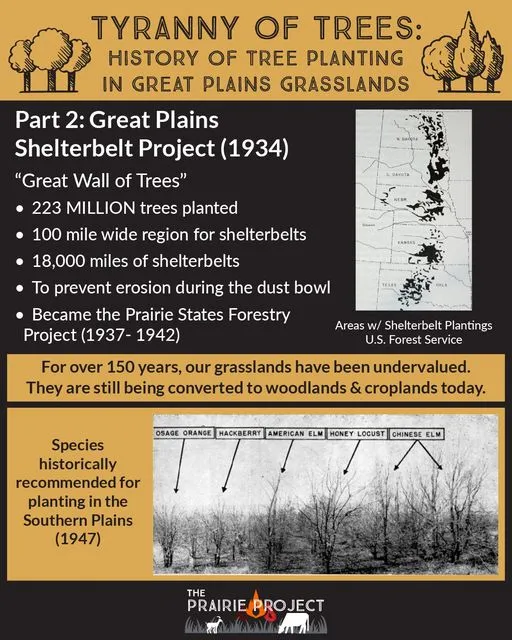
Tyranny of Trees: History of Tree Planting in Great Plains Grasslands
Part 2: Great Plains Shelterbelt Project (1934)
"Great Wall of Trees"
For over 150 years, our grasslands have been undervalued.
They are still being converted to woodlands & croplands today.
Species historically recommended for planting in the Southern Plains (1947)
Prescribed Fire & Patch Burn Grazing
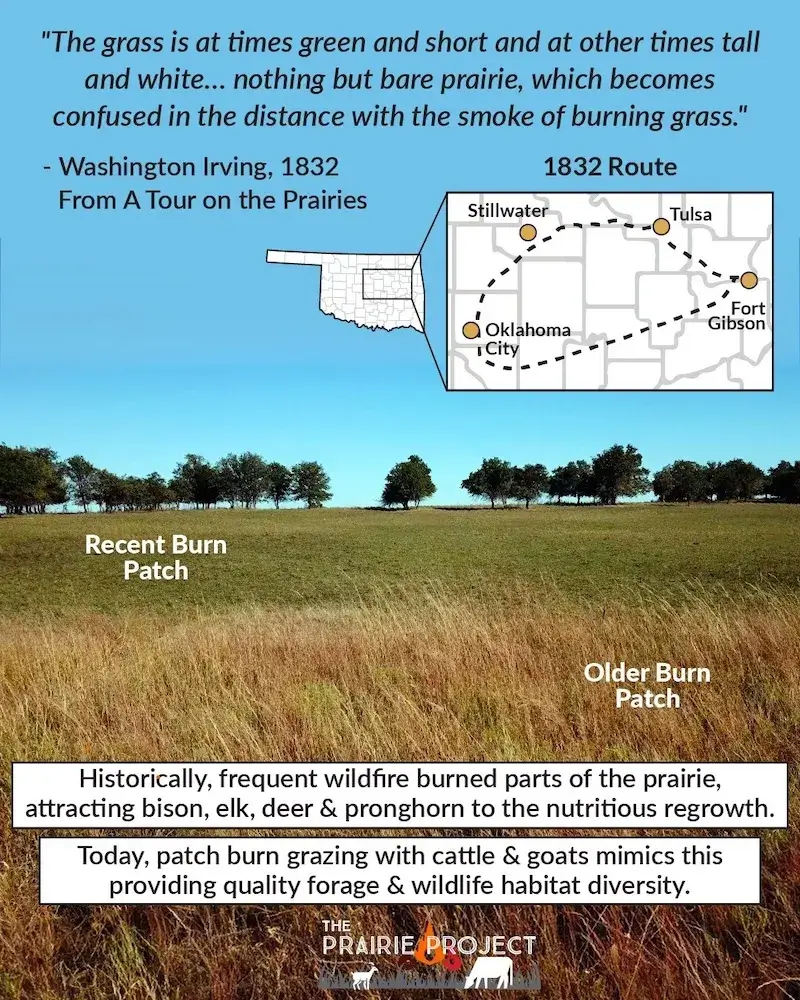
"The grass is at times green and short and at other times tall and white… nothing but bare prairie, which becomes confused in the distance with the smoke of burning grass."
- Washington Irving, 1832, From A Tour on the Prairies
Historically, frequent wildfire burned parts of the prairie, attracting bison, elk, deer & pronghorn to the nutritious regrowth.
Today, patch burn grazing with cattle & goats mimics this providing quality forage & wildlife habitat diversity.
Prescribed Fire & Patch Burn Grazing
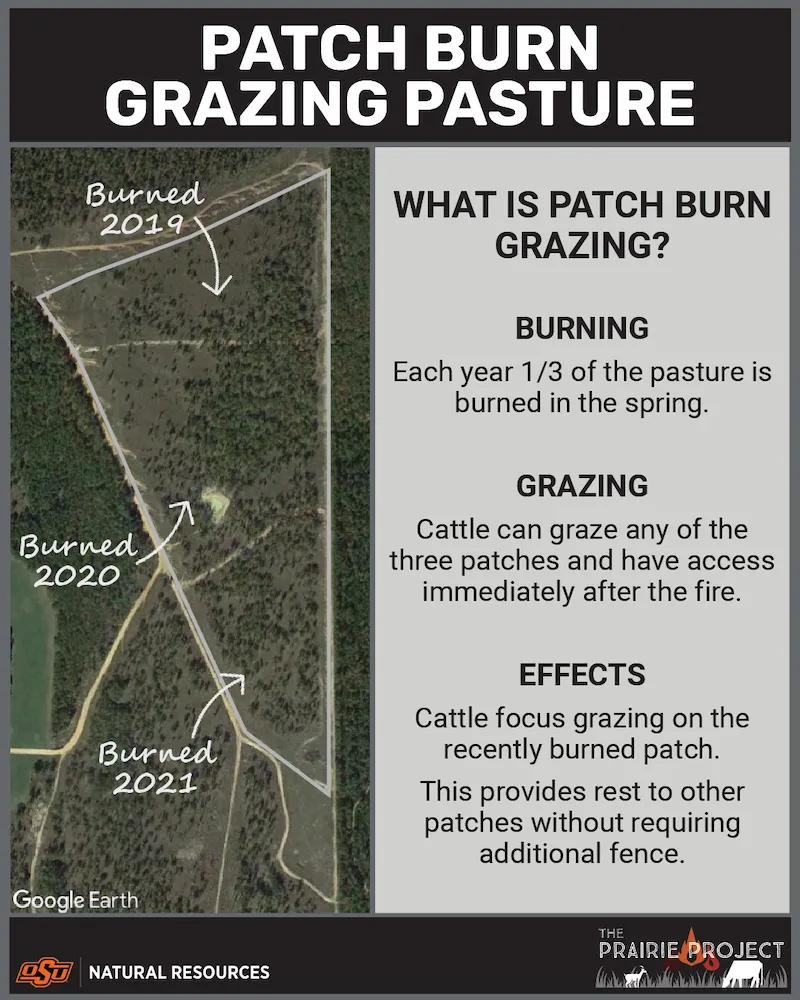
Patch Burn Grazing Pasture
What is patch burn grazing?
Burning: each year _ of the pasture is burned in the spring.
Grazing: cattle can graze any of the three patches and have access immediately after fire.
Effects: cattle focus grazing on the recently burned patch. This provides rest to other patches without requiring additional fence.
Prescribed Fire & Patch Burn Grazing
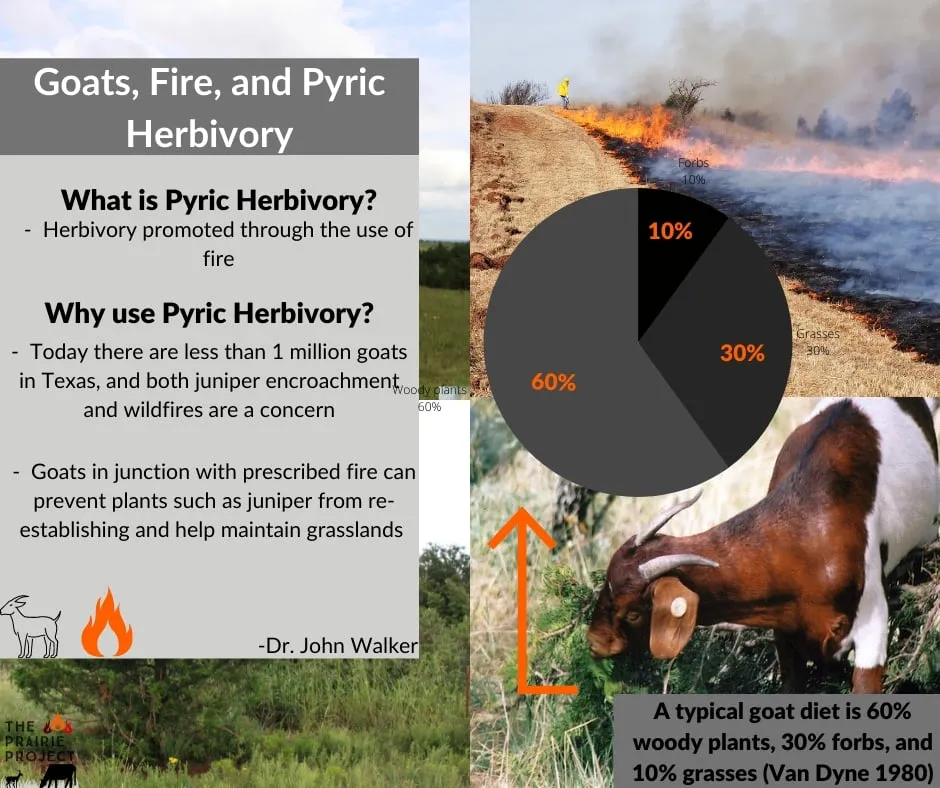
In 1965, 4.6 million goats existed in the Texas Hill Country, and juniper encroachment and wildfires were managed. Over the last fifty years that number has dropped to less than 1 million, and the total amount of wildfires and juniper have increased at an alarming rate. However, a new solution has presented itself in the form of pyric herbivory or �herbivory promoted through the use of fire�. The Prairie Project has established demonstration ranches throughout Texas, Oklahoma, Nebraska, and Kansas to ensure this knowledge is passed along to producers, resource managers, agribusiness leaders, and the public who are also fighting the battle against woody plant encroachment.
To learn more about the Prairie Project and our goals you can navigate to: https://www.theprairieproject.org/.../solut.../multi-species
#brushmanagement#westtexasrangelands#rangelands#goats
Multi-Species Grazing
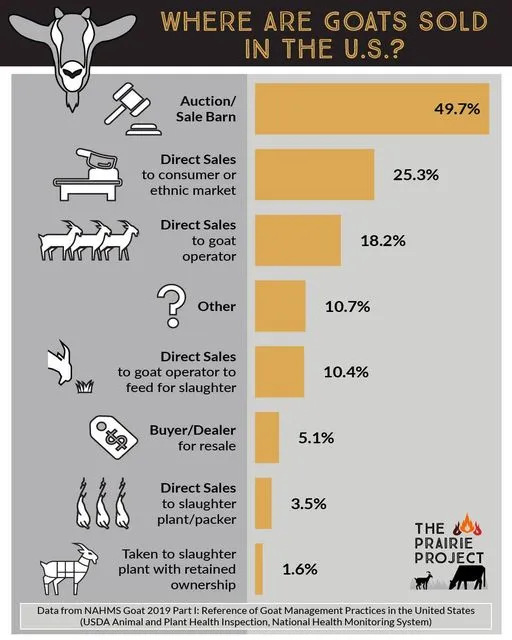
Where are goats sold in the U.S.?
47.9% Auction/Sale Barn
25.3% Direct Sales - consumer or ethnic market
18.2% Direct Sales - to goat operator
10.7% Other
10.4% Direct Sales - to goat operator to feed for slaughter
5.1% Buyer/Dealer - for resale
3.5% Direct Sales - to slaughter plant/packer
1.6% Taken to slaughter with retained ownership
Data from NAHMS Goat 2019 Part I: Reference of Goat Management Practices in the United States
(USDA Animal and Plant Health Inspection, National Health Monitoring System)
https://www.aphis.usda.gov/.../tab.../goat-mgmt-practices-us
Woody Encroachment
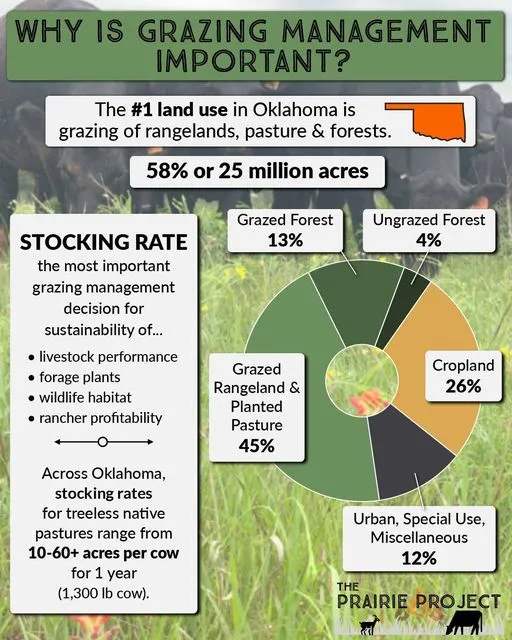
The #1 Land use in Oklahoma is grazing of Rangelands, Pasture and Forests
58% or 25 million acres
45% Grazed Rangeland & Planted Pasture
13% Grazed Forest
4% Ungrazed Forest
16% Cropland
12% Urban, special use, Miscellaneous
Stocking rate is the most important grazing management decision for sustainability of...
Across Oklahoma, stocking rates range from 10-60+ acres per cow for 1 year (1,300lb cow) on native pastures.
See stocking rates for your rangeland on the Rangeland Analysis Platform (link in bio)!
USDA land use data
Prescribed Fire & Patch Burn Grazing
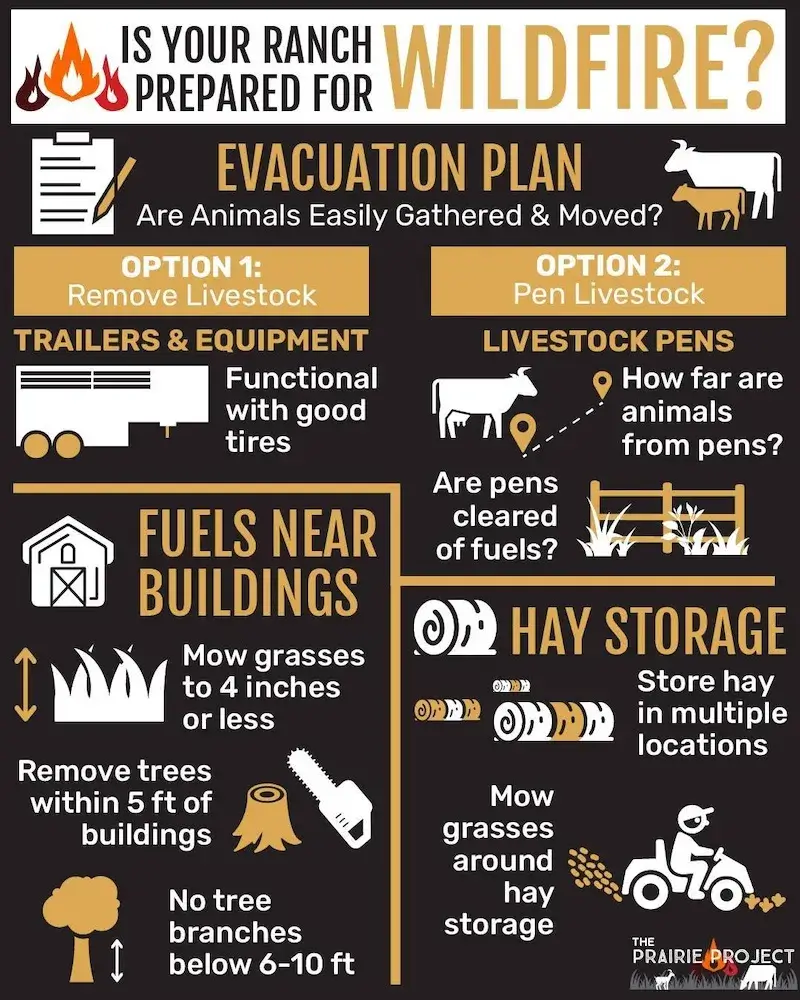
Is your ranch prepared for wildfire?
EVACUATION PLAN: Are animals easily gathered and moved?
Option 1: Remove Livestock
Trailers & Equipment - Functional with good tires
Option 2: Pen Livestock
Livestock Pens - How far are are animals from pens? Are pens cleared of fuels?
FUELS NEAR BUILDINGS
Mow grasses to 4 inches or less
Remove trees within 5 ft of buildings
No tree branches below 6-10 ft
HAY STORAGE
Store hay in multiple locations
Mow grasses around hay storage
For more information on preparing the ranch and farm for wildfire, click the link! http://bit.ly/WildfirePrepOSU
Prescribed Fire & Patch Burn Grazing
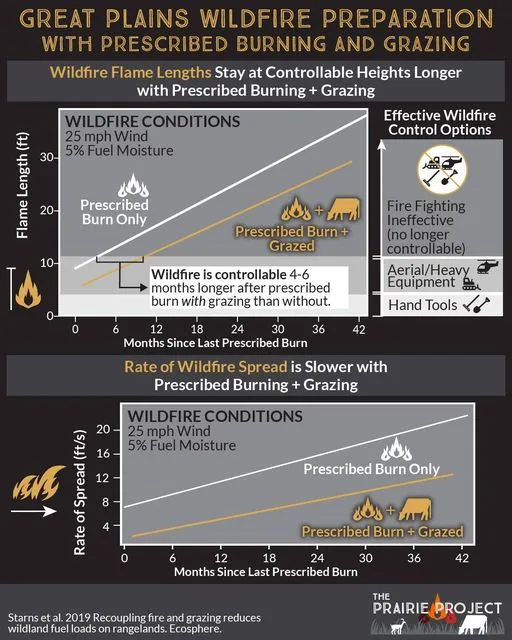
Great Plains Wildfire Preparation with Prescribed Burning and Grazing
Wildfire Flame Lengths Stay at Controllable Heights Longer with Prescribed Burning + Grazing
Wildfire Conditions: 25mph wind, 5% fuel moisture
Prescribed Burn Only vs Prescribed Burn + Grazed.
Data shows that wildfire is controllable 4-6 months longer after prescribed burn with grazing than without.
Rate of Wildfire Spread is Slower with Prescribed Burning + Grazing.
Wildfire Conditions: 25mph wind, 5% fuel moisture
Prescribed Burn Only VS Prescribed Burn + Grazed.
Data shows the rate of spread is lower for longer after prescribed burn with grazing than without.
Starns et al. 2019 Recoupling fire and grazing reduces wildland fuel loads on rangelands. Ecosphere. https://doi.org/10.1002/ecs2.2578
%20(1).webp)
Wildlife Management
Do Wild Grazers Prefer Recent Burns?
Pyric Herbivory: Instinctual foraging driven by high-quality regrowth after recent fire.
- Shifts use by wildlife and livestock.
- Provides rest to unburned areas and waterways.
- Creates habitat variability for other wildlife.
White-tailed Deer
In burned areas, roundhead lespedeza was grazed and purple prairie clover was preferred while both were avoided in unburned areas. Percent of plants grazed was higher in burned areas than unburned (Nisi et al. 2015).
Elk
Up to 1 year after fire, elk use days on burned areas increased by an average of 94 while elk use days on unburned areas decreased by an average of 69 (van Dyke & Darragh 2007).
Mule Deer
Selected for prescribed burns in almost all seasons with greater selection for more recent burns (<2 years old) (Roerick et al. 2019).
Pronghorn
Used burned range significantly more than unburned. They used burned prickly pear cactus heavily (Courtney 1989).
Bighorn Sheep
Used burned sites more than adjacent unburned sites on all areas studied (Brentz & Woodward 1988).

Wildlife Management
Windbreaks & Shelterbelts:
Ecological Traps for White-tailed Deer Fawns
Higher Fawn Survival: Where more grassland patches in home range.
Lower Fawn Survival: Where more shelterbelts in home range.
Tree plantings attract female deer seeking fawn cover. Unfortunately, coyotes can easily search these plantings, locating fawns and increasing predation mortalities.
Grovenberg et al. 2012 Survival of white-tailed deer fawns in the grasslands of the northern Great Plains https://doi.org/10.1002/jwmg.339
Fawn photo: H. Pippert used and edited under CC BY NC 4.0 https://creativecommons.org/licenses/by-nc/4.0/
.webp)
Woody Encroachment
Learning from Texas ranchers fighting woody plant encroachment!
Crockett County, TX
Forage Production Loss:
1990-2019: 1.8 billion lbs
2019: 210 million lbs
Grassland converted to woodland on rangelands since 1990:
157,468 ac
Hoover K. Bar Ranch - Ozona, TX
Managing invasive brush while teaching the next generation of land stewards on the beneficial practices of:
-Patch-burning
-Pyric herbivory with Angora goats
-Plant identification
"If you treat your land right it will stay right. You will stay green longer in a dry spell and you'll green up before you even get a spring rain".
-Hoover K. Bar Ranch
Check out https://www.theprairieproject.org/ to learn more about how ranchers are fighting woody plant encroachment!
To see production losses in your county, click the link!
https://www.wlfw.org/yieldgap/
Texas A&M AgriLife Extension Service Sonora Research Station Endowment Fund
.webp)
Woody Encroachment
Dealing with Woody Plant Encroachment at our Prairie Project Research Ranches!
Edwards County, Texas
Forage Production Loss:
1990-2019: 8 billion lbs
2019: 583 million lbs
Grassland converted to woodland on rangelands since 1990: 278,419 ac
Texas A&M AgriLife Research Sonora Research Station - Sonora, TX Conducting ongoing research comparing:
Control (no fire and grazing)
Prescribed fire only
Browsing only
Prescribed fire and browsing
About Sonora Research Station:
-Edwards Plateau
-Rangeland type is grassland savanna, juniper-woodland
-22-24 inches annual precipitation
-3,462 acres
Check out https://www.theprairieproject.org/ to learn more about how AgriLife research stations are dealing with woody plant encroachment!
To see production losses in your county, click the link!
https://www.wlfw.org/yieldgap/
Goat Photo by Coleson Brown
Sonora Research Station Endowment Fund
.webp)
Woody Encroachment
Kansas Rangeland Production Lost to Woody Encroachment
Statewide Rangeland Production in 2022: 45 billion lbs
Grassland converted to woodland since 1990 (on rangelands): 988,133 acres
Loss of Productivity on Kansas Rangelands
Forage lost is equal to…
Forage lost could support…
Forage lost could support…
To see production losses in your county, click the link! https://www.wlfw.org/yieldgap/
.webp)
Woody Encroachment
Dealing with Woody Plant Encroachment at our Prairie Project Research Ranches!
Menard County, Texas
Forage Production Loss:
1990-2019: 3.4 billion lbs
2019: 347 million lbs
Grassland converted to woodland on rangelands since 1990:
96,827 ac
Martin Research Station - Menard, TX
Monitoring invasive brush while conducting research on the beneficial practices of:
-Multi-species grazing
-Large scale patch burning
-Remote sensing surveys
About Martin Research Station:
-Rangeland type is grassland savanna, mixed-brush, and live oaks
-24-26 inches annual precipitation
-4,700 acres
Check out theprairieproject.org to learn more about how our Texas A&M AgriLife research stations are dealing with woody plant encroachment!
To see production losses in your county, click the link!
Rangeland Production Lost to Tree Encroachment (wlfw.org)
Texas A&M AgriLife Extension Service
.webp)
Woody Encroachment
Losing Nebraska Rangeland Production to Woody Encroachment
Statewide Rangeland Production in 2022: 36 billion lbs
Grassland converted to woodland since 1990 (on rangelands): 292,686 acres
Loss of Productivity on Nebraska Rangelands
Forage lost is equal to…
Forage lost could support…
Forage lost could support…
You can see production losses in your county, at the link! https://www.wlfw.org/yieldgap/
.webp)
Woody Encroachment
CORRECTION! 9,987,428 acres has been changed to 2,221918 acres. We accidentally used the Texas grassland acres converted to woodland in the original visual. All other numbers for Oklahoma are correct.
Losing Productive Rangelands in Oklahoma
61.4 billion pounds: 2019 statewide rangeland production
9,987,428 acres: Grassland converted to woodland on rangelands since 1990
Loss of Productivity on Oklahoma Rangelands
Losses in 2019: 8.9 billion pounds (13% of total)
Losses 1990-2019: 153 billion pounds
Forage lost is equal to…
7.5 million round bales (1,200 lbs each) in 2019
128 million round bales (1,200 lbs each) from 1990-2019
Forage lost could support…
728,069 cows (1,300 lbs/year) in 2019
12 million cows (1,300 lbs/ year) from 1990-2019
Forage lost could support…
3.2 million steers (700lbs/6mos) in 2019
55 million steers (700lbs/6mos) from 1990-2019
To see production losses in your county, click the link! https://www.wlfw.org/yieldgap/
.webp)
Woody Encroachment
Learning from Texas ranchers fighting woody plant encroachment
Schleicher County, Texas
Forage Production Loss
1990-2019: 1.39 billion lbs
2019: 129 million lbs
Grassland converted to woodland on rangelands since 1990: 87, 596 ac
Duff Ranch - Christoval, TX
Protecting historical grasslands and practicing responsible prescribed burning using:
-Wide fire breaks
-Good fuel and weather conditions
-Burn intervals of 2-3 years
"A successful fire is one that accomplishes the goals set out in the planning of the burn. I have never had a bad one". -Duff Ranch
Check out https://www.theprairieproject.org/ to learn more about how ranchers are fighting woody plant encroachment!
To see production losses in your county, click the link!
https://www.wlfw.org/yieldgap/
.webp)
Woody Encroachment
Losing Texas Rangeland Production to Woody Encroachment
Statewide Rangeland Production in 2022: 144 billion lbs
Grassland converted to woodland since 1990 (on rangelands): 5,014,982 acres
Loss of Productivity on Texas Rangelands
Forage lost is equal to…
Forage lost could support…
Forage lost could support…
To see production losses in your county, click the link! https://www.wlfw.org/yieldgap/
.webp)
Woody Encroachment
Learning from Texas ranchers fighting woody plant encroachment
Tom Green County, Texas
2019 Forage Production Loss:
1990-2019: 1.2 billion lbs
2019: 109 million lbs
Grassland converted to woodland on rangelands since 1990:
86,737 ac
Head Of River Ranch - Christoval, TX Protecting open spaces and working landscapes from woody brush encroachment using:
-Prescribed Fire
-Rotational grazing and rest to accumulate fuels for fire
Rocking Chair Ranch - San Angelo, TX Maintaining grassland savannas and forage productivity using:
-Prescribed Fire
-Multi-Species Grazing
-Patch-Burn Grazing
Check out https://www.theprairieproject.org/ to learn more about how ranchers are fighting woody plant encroachment!
To see production losses in your county, click the link!
https://www.wlfw.org/yieldgap/
Rocking Chair Ranch
Head of the River Ranch
.webp)
Woody Encroachment
The final species in this three part Cedar Series is Ashe Juniper. Also known as blueberry cedar, this tree produces berries that are blue and fleshy. Like Eastern Redcedar, Ashe juniper is non-resprouting and can be controlled with fire in a similar manner. Ashe juniper is a smaller tree than Eastern Redcedar and will only reach mature heights of 15-30 feet. This species often has a single trunk and a shredding bark texture. Although this tree is commonly confused with Redberry Juniper, no wax flecks are present on the leaves of Ashe juniper.
.webp)
Woody Encroachment
Know your cedar!
Eastern Redcedar is the second species in this series. It is the most abundant in the Southern Great Plains. This cedar type is non-resprouting and is readily controlled with fire. Historically, this plant was only found in rocky areas and other places where wildfires rarely reached. Eastern Redcedar can reach heights over 60 ft. tall and has rapidly spread through prairies following the suppression of fire. Smaller trees are easily managed under “normal” burning conditions, but larger tree control may require more extreme burning conditions or mechanical control. This plant can be identified by its evergreen scaly leaves, pyramid-shape and blue cones or ”berries”. In some locations, it is reported to hybridize with Ashe Juniper.
.webp)
Woody Encroachment
Know your cedar!
Different types of native juniper, or cedar, are found throughout the Great Plains. Fire can be an effective tool to manage juniper encroachment; however, some cedar species are able to resprout after fire, making them difficult to manage with fire alone. This series will focus on identifying three key species of juniper in the southern Great Plains and classifying them as resprouting or non-resprouting.
The first species in our cedar series is Redberry Juniper. Redberry is a multi-stemmed, shrubby tree that is commonly found in the northern and western parts of Texas and southwest Oklahoma. The smallest of the three in this series, Redberry only matures to heights up to 15 feet. This species does resprout after fire, so it is usually considered a nuisance and may be difficult to remove after it has established itself in a landscape. Although closely resembling Ashe juniper, Redberry can be distinguished by the wax-like, white residue found on the leaves by resin producing glands.
Helpful tip: Goats will browse the palatable regrowth of redberry juniper after fire. This is a great way to incorporate multi-species grazing & pyric herbivory into your rangeland management practices!