
Prescribed Fire & Patch Burn Grazing
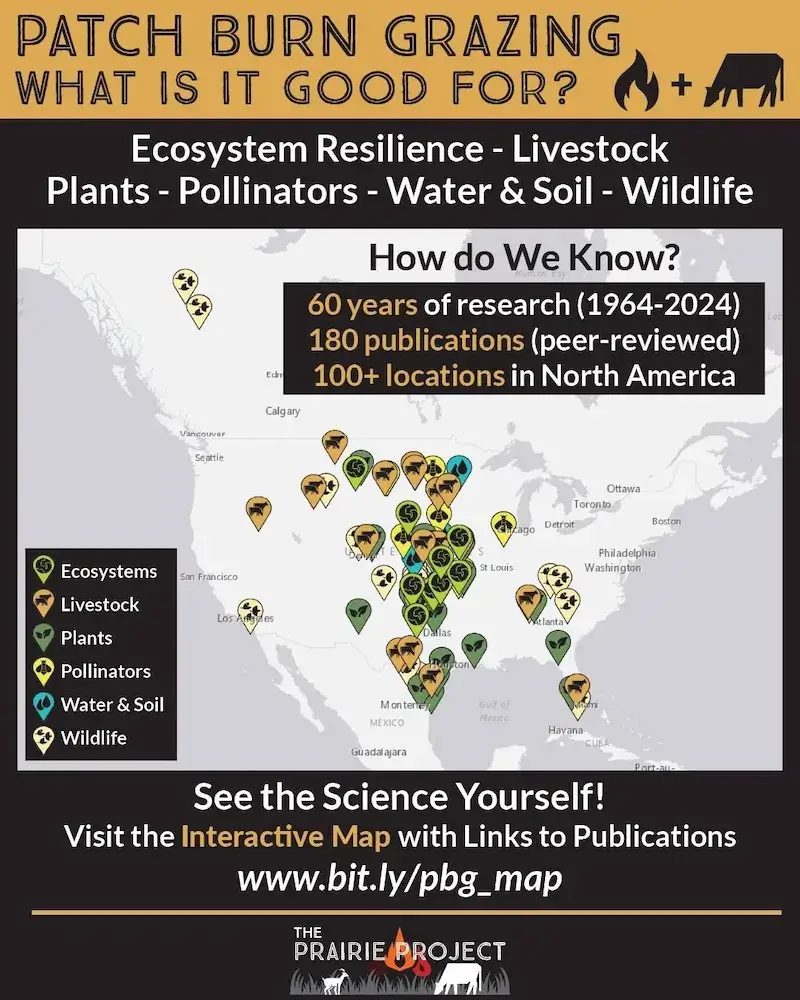
Patch Burn Grazing
What is it Good For?
- Ecosystem Resilience
- Livestock
- Plants
- Pollinators
- Water & Soil
- Wildlife
How do we know?
60 years of research (1964-2024)
180 publications (peer-reviewed)
100+ locations in North America
See the Science Yourself!
Visit the Interactive Map with Links to Publication
Prescribed Fire & Patch Burn Grazing
Can you use prescribed fire on your land without grazing deferment or rest?
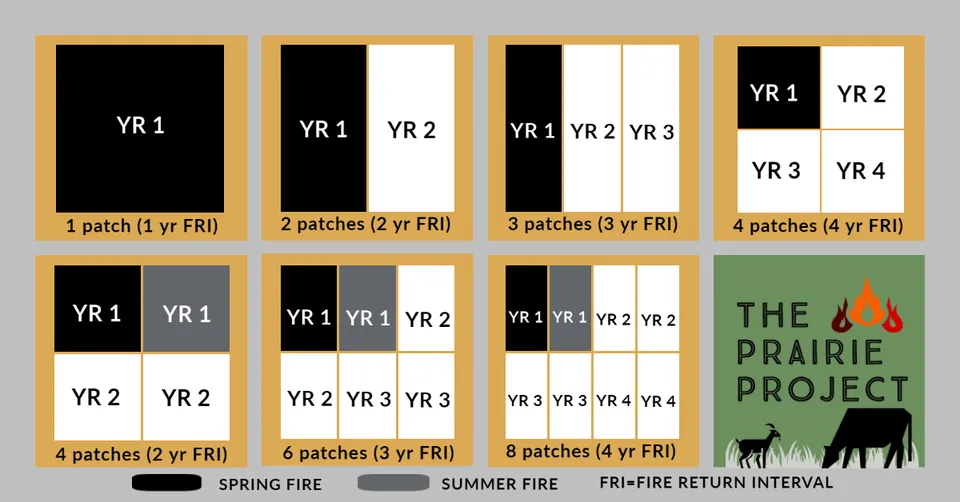
When an entire pasture is burned, cattle and other livestock grazing is often stopped before and after burning to allow enough fuel to grow. With patch burning, only a portion of the pasture is burned, and grazing does not need to be stopped. This is because animals are attracted to palatable forage regrowing in the recently burned area. This concentrated use provides plants in the unburned areas rest from grazing, allowing more fuel to accumulate for future burns as fire is rotated around the pasture and diversity is created in the landscape.
The size/number of patches within each pasture, season of burn, and fire return interval (years between fires) can be altered to fit the goals of an operation. This visual provides an example of 7 different patch-burn systems. Patch size and shape may vary and do not need to be square.
Click the link to learn more on how having many patches burned at different times provides spatial heterogeneity which can stabilize livestock productivity in a changing climate:
[https://bit.ly/31ExM4L](https://bit.ly/31ExM4L)

Prescribed Fire & Patch Burn Grazing
Is Patch Burn Grazing Good for Gains?
Stocker Cattle Weight Gains on Mixed-grass Prairie
Gain per Animal (lbs/head/year) plotted by year (1999-2009)
Values shown for Patch Burn Grazing and for Traditional Grazing (no fire)
(Weight gain followed rainfall)
Cattle grazing patch burned gained...
7-22 lbs more in years 1-4
42-62 lbs more in years 5-11
Research at Marvin Klemme Range Research Station near Bessie, OK
Pyric�Herbivory and Cattle Performance in Grassland Ecosystems
[https://doi.org/10.2111/REM-D-10-00192.1](https://doi.org/10.2111/REM-D-10-00192.1)
Wildlife Management
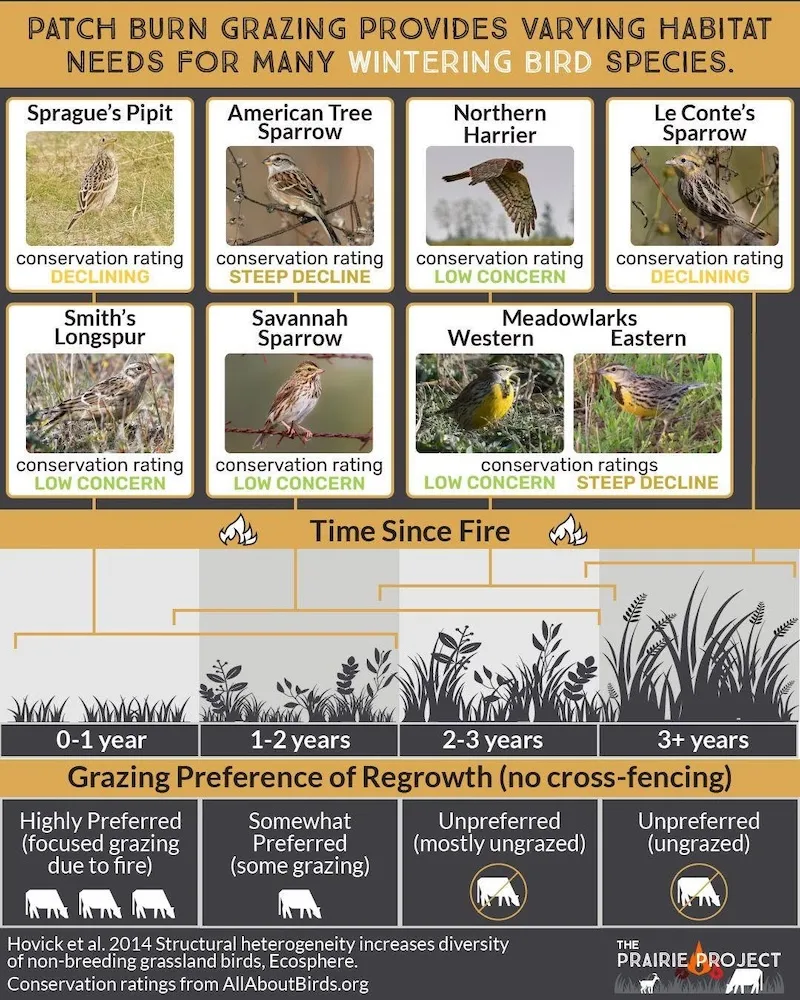
Patch Burn Grazing Provides Varying Habitat Needs for Many BREEDING BIRD Species
Having all in one pasture can provide habitat for more species.
From Fuhlendorf et al. 2006. Should heterogeneity be the basis for conservation? Grassland bird response to fire and grazing. https://pubmed.ncbi.nlm.nih.gov/17069365/
Killdeer
Conservation Rating: Low concern
- Time Since Fire: 0-1 year
- Grazing Preference (no cross fencing): Highly preferred (focused grazing)
Lark Sparrow
- Conservation Rating: Low concern
- Time Since Fire: 0-1 year
- Grazing Preference (no cross fencing): Highly preferred (focused grazing)
Upland Sandpiper
- Conservation Rating: Low concern
- Time Since Fire: 0-1 AND 1-2 years
- Grazing Preference (no cross fencing): Highly preferred (focused grazing) AND Somewhat preferred (some grazing)
Grasshopper Sparrow
- Conservation Rating: Steep decline
- Time Since Fire: 1-2 AND 2-3 years
- Grazing Preference (no cross fencing): Somewhat preferred (some grazing) AND Unpreferred (mostly ungrazed)
Eastern Meadowlark
- Conservation Rating: Steep decline
- Time Since Fire: 1-2 AND 2-3 years
- Grazing Preference (no cross fencing): Somewhat preferred (some grazing) AND Unpreferred (mostly ungrazed)
Dickcissel
- Conservation Rating: Low concern
- Time Since Fire: 1-2, 2-3 AND 3+ years
- Grazing Preference (no cross fencing): Unpreferred (mostly ungrazed) AND Unpreferred (ungrazed)
Henslow's Sparrow
- Conservation Rating: Declining
- Time Since Fire: 3+ years
- Grazing Preference (no cross fencing): Unpreferred (ungrazed)
Conservation Concern: https://www.allaboutbirds.org/guide/

Prescribed Fire & Patch Burn Grazing
Patch Burn Grazing Provides Varying Habitat Needs for Many BREEDING BIRD Species
Having all in one pasture can provide habitat for more species.
From Fuhlendorf et al. 2006. Should heterogeneity be the basis for conservation? Grassland bird response to fire and grazing. https://pubmed.ncbi.nlm.nih.gov/17069365/
Killdeer
Conservation Rating: Low concern
- Time Since Fire: 0-1 year
- Grazing Preference (no cross fencing): Highly preferred (focused grazing)
Lark Sparrow
- Conservation Rating: Low concern
- Time Since Fire: 0-1 year
- Grazing Preference (no cross fencing): Highly preferred (focused grazing)
Upland Sandpiper
- Conservation Rating: Low concern
- Time Since Fire: 0-1 AND 1-2 years
- Grazing Preference (no cross fencing): Highly preferred (focused grazing) AND Somewhat preferred (some grazing)
Grasshopper Sparrow
- Conservation Rating: Steep decline
- Time Since Fire: 1-2 AND 2-3 years
- Grazing Preference (no cross fencing): Somewhat preferred (some grazing) AND Unpreferred (mostly ungrazed)
Eastern Meadowlark
- Conservation Rating: Steep decline
- Time Since Fire: 1-2 AND 2-3 years
- Grazing Preference (no cross fencing): Somewhat preferred (some grazing) AND Unpreferred (mostly ungrazed)
Dickcissel
- Conservation Rating: Low concern
- Time Since Fire: 1-2, 2-3 AND 3+ years
- Grazing Preference (no cross fencing): Unpreferred (mostly ungrazed) AND Unpreferred (ungrazed)
Henslow's Sparrow
- Conservation Rating: Declining
- Time Since Fire: 3+ years
- Grazing Preference (no cross fencing): Unpreferred (ungrazed)
Conservation Concern: [https://www.allaboutbirds.org/guide/](https://www.allaboutbirds.org/guide/)
.webp)
Multi-Species Grazing
45 Years of Grazing in Texas (1948 - 1993)
Plant Biodiversity
Species Richness - # species per square meter
45.5 : Heavy - continuous grazing with cows sheep & goats
69.5 : Moderate - rotational grazing with cows, sheep & goats
70 : Browse - continuous grazing with 23 yrs goats only, 21 yrs goats, cows & sheep
88 : No Livestock
Goats do NOT eat everything.
Number of plant species per square meter was similar in...
Allred et al. 2012 Herbivore species and grazing intensity regulate community composition and an encroaching woody plant in semi-arid rangeland https://doi.org/10.1016/j.baae.2012.02.007
Sonora Research Station Endowment Fund
.webp)
Woody Encroachment
How does the increase of woody plants within the Great Plains affect our ecosystem?
Conversion of prairies to juniper dominated woodlands negatively impacts many ecosystem services, including those listed in the table below.
Visit the link below to learn how private citizens are restoring fire in the Great Plains.
https://bit.ly/3kG8DNO
Prescribed Fire & Patch Burn Grazing
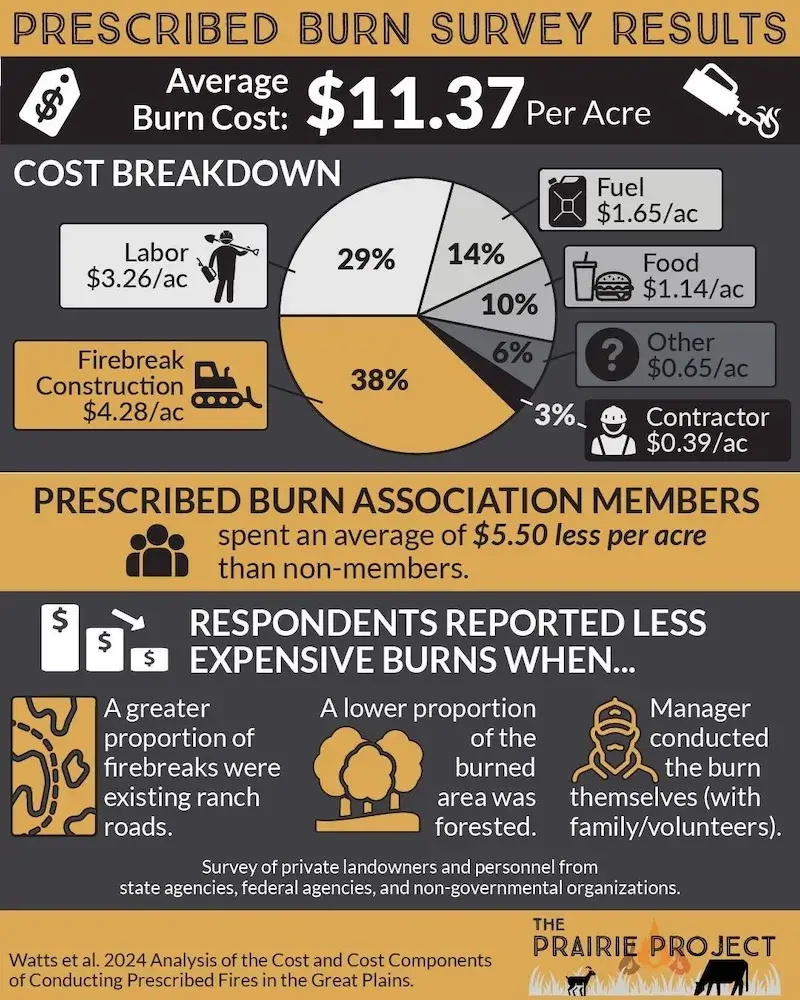
Prescribed Burn Survey Results
Average Burn Cost: $11.37 per acre
Cost Breakdown
- Firebreak Construction: 38%, $4.28/ac
- Labor: 29%, $3.26/ac
- Fuel: 14%, $1.65/ac
- Food: 10%, $1.14/ac
- Other: 6%, $0.65/ac
- Contractor: 3%, $0.39/ac
Prescribed Burn Association Members spent an average of $5.50 less per acre than non-members.
Respondents reported less expensive burns when...
- A greater proportion of firebreaks were existing ranch roads.
- A lower proportion of the burned area was forested.
- Manager conducted the burn themselves (with family/volunteers).
Survey of private landowners and personnel from state agencies, federal agencies, and non-governmental organizations.
Watts et al. 2024 Analysis of the Cost and Cost Components of Conducting Prescribed Fires in the Great Plains. https://doi.org/10.1016/j.rama.2023.11.002
Prescribed Fire & Patch Burn Grazing
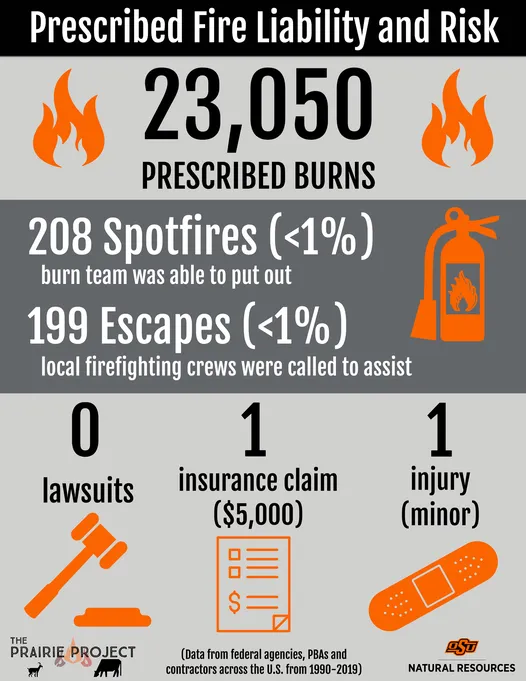
Is prescribed fire risky?
Many people do not use prescribed fire as a management tool because they believe there is high liability and risk. When planned and carried out under the proper conditions, the risk of damage is actually very low. From 23,050 burns across the U.S., less than 2% had spotfires or escapes with only 1 insurance claim and 1 minor injury reported. Check out this OSU factsheet to read more http://bit.ly/OSUBurnRisk
The Prairie Project
Prescribed Fire & Patch Burn Grazing
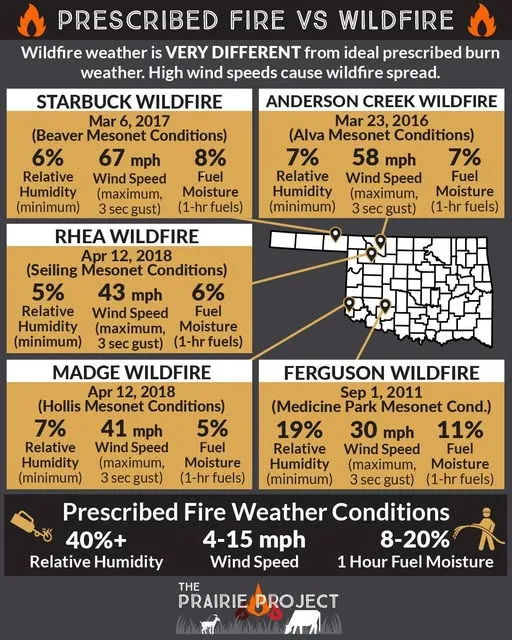
Prescribed Fire VS Wildfire
Wildfire weather is VERY DIFFERENT from ideal prescribed burn weather. High wind speeds cause wildfire spread.
Wildfires in Oklahoma Factsheet _ https://extension.okstate.edu/.../wildfires-in-oklahoma.html
Starbuck Wildfire - Mar 6, 2017
Beaver Mesonet Conditions
- 6% Relative Humidity (minimum)
- 67 mph Wind Speed (maximum, 3 second gust)
- 8% Fuel Moisture (1-hour fuels)
Anderson Creek Wildfire - Mar 23, 2016
Alva Mesonet Conditions
- 7% Relative Humidity (minimum)
- 58 mph Wind Speed (maximum, 3 second gust)
- 7% Fuel Moisture (1-hour fuels)
Rhea Wildfire - April 12, 2018
Seiling Mesonet Conditions
- 5% Relative Humidity (minimum)
- 43 mph Wind Speed (maximum, 3 second gust)
- 6% Fuel Moisture (1-hour fuels)
Madge Wildfire - April 12, 2018
Hollis Mesonet Conditions
- 7% Relative Humidity (minimum)
-41 mph Wind Speed (maximum, 3 second gust)
- 5% Fuel Moisture (1-hour fuels)
Ferguson Wildfire - Sep 1, 2011
Medicine Part Mesonet Conditions
- 19% Relative Humidity (minimum)
- 30 mph Wind Speed (maximum, 3 second gust)
- 11% Fuel Moisture (1-hour fuels)
Prescribed Fire Weather Conditions
- 40%+ Relative Humidity
- 4-15 mph Wind Speed
- 8-20% 1-Hour Fuel Moisture
Weather data from the Oklahoma Mesonet
Wildlife Management
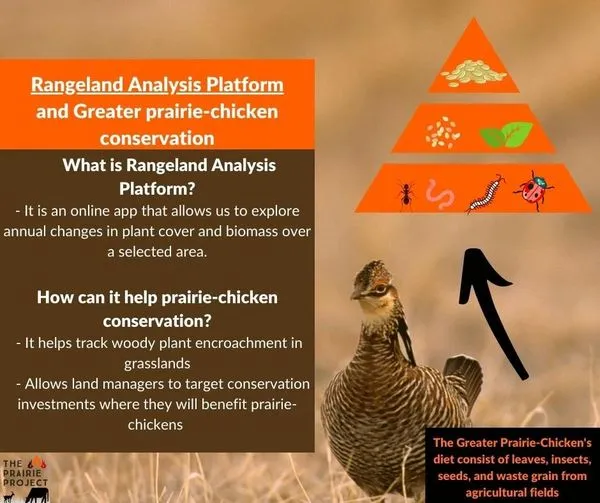
Woody plant encroachment is one of the biggest drivers of grassland loss throughout the Great Plains. One grassland bird, the Greater Prairie-Chicken is especially affected by this change as their habitat is being taken over by Eastern red-cedar and Honey mesquite. However, new technology such as the Rangeland Analysis Platform (RAP) Is being used by scientists and conservationists in Fort Riley, Nebraska to help track woody plant encroachment and target conservation investments that will benefit prairie-chickens.
The Prairie Project actively uses the Rangeland Analysis Platform to track woody plant encroachment in the Great Plains, and is currently working to educate the public on this new application. To read more on the Prairie Project’s goals mission can navigate to https://www.theprairieproject.org/pro.../what-is-the-problem
To read more on this article you can navigate to: https://bit.ly/3sRicAU
#rangelands #brushmanagement #AgriLifeExtension Oklahoma State University Natural Resources Extension West Texas
Woody Encroachment
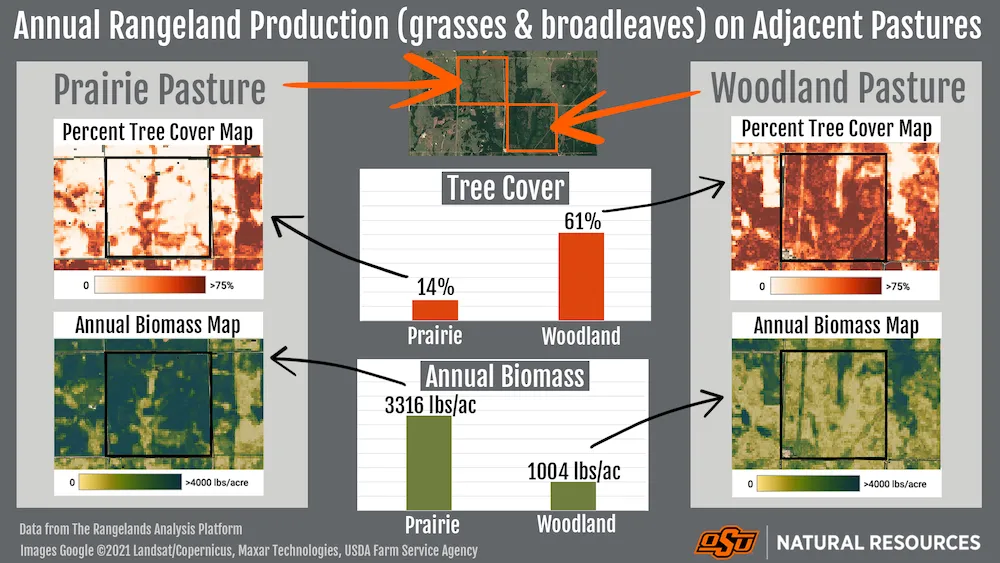
In two adjacent pastures, tree cover and annual biomass (grasses and broadleaves) are shown.
The prairie pasture has low tree cover and high annual biomass production. The woodland pasture has higher tree cover and, consequently, lower annual biomass production.
Look at your pasture production on the Rangelands Analysis Platform! https://bit.ly/RangelandsApp

Prescribed Fire & Patch Burn Grazing
OSU researchers with the Prairie Project have added goats to our Payne County cattle pastures which are managed with patch-burn grazing.
Here are some of the numbers from our first kid crop.
80% of dams first time mothers
1.4 kids weaned per doe
100 days old at weaning
78% of dam weight weaned
Doe kids (sold as replacements) $240/head
Buck kids (sold at auction) $2.99/pound
89% of initial animal cost recouped after 1st kid crop (does, bucks, donkeys & dogs)
The Prairie Project
Multi-Species Grazing
Check out some of our goat numbers from research in Oklahoma!
%20(1).webp)
Prescribed Fire & Patch Burn Grazing
How does prairie grass respond to multiple fires?
Big Bluestem (Andropogon gerardii)
Root biomass, shoot biomass and flowering stalks ALL INCREASED with more fires.
Big Bluestem Flowering Stalks (after 10 years)
0 burns = 3 stalks/sq ft
2 burns = 3 stalks/sq ft
3 burns = 5 stalks/sq ft
4 burns = 12 stalks/sq ft
Big Bluestem Root Biomass (after 10 years)
0 burns = 8,000 lbs/ac
2 burns = 10,000 lbs/ac
3 burns = 11,200 lbs/ac
4 burns = 11,600 lbs/ac
Big Bluestem Shoot Biomass (after 10 years)
0 burns = 3,200 lbs/ac
2 burns = 3,200 lbs/ac
3 burns = 5,200 lbs/ac
4 burns = 12,100 lbs/ac
Data from Elmer et al. 1963 Productivity of Two Prairie Grasses in Relation to Fire Frequency
[https://www.jstor.org/stable/1932186](https://www.jstor.org/stable/1932186)
.webp)
Prescribed Fire & Patch Burn Grazing
How does Eastern Gamagrass Respond to Fire?
Euchee Butterfly Farm, Bixby OK
Eastern gamagrass regrowth 2 MONTHS after July burn.
Nearby, unburned plants have seedheads & mature leaves.
Eastern Gamagrass (Tripsacum dactyloides)
- Large rhizomatous grass
- Preferred forage
- Resprouts vigorously after fire
Fire was a natural process in ecosystems where eastern gamagrass grew historically.
Research from Mexico shows that eastern gamagrass BURNED IN MARCH
GREW MORE LEAVES PER TILLER than unburned plants.
Moya-Raygoza 1995 Fire Effects on Insects Associated with the Gamagrass Tripsacum dactyloides in Mexico [https://doi.org/10.1093/aesa/88.4.434](https://doi.org/10.1093/aesa/88.4.434)
.webp)
Prescribed Fire & Patch Burn Grazing
How does prairie grass respond to multiple fires?
Indiangrass (Sorghastrum nutans)
Root biomass, shoot biomass and flowering stalks ALL INCREASED with more fires.
Indiangrass Flowering Stalks (after 10 years)
0 burns = 3 stalks/sq ft
2 burns = 4 stalks/sq ft
3 burns = 8 stalks/sq ft
4 burns = 16 stalks/sq ft
Indiangrass Root Biomass (after 10 years)
0 burns = 7,000 lbs/ac
2 burns = 8,600 lbs/ac
3 burns = 8,700 lbs/ac
4 burns = 9,200 lbs/ac
Indiangrass Shoot Biomass (after 10 years)
0 burns = 4,200 lbs/ac
2 burns = 4,700 lbs/ac
3 burns = 5,600 lbs/ac
4 burns = 13,700 lbs/ac
Data from Elmer et al. 1963 Productivity of Two Prairie Grasses in Relation to Fire Frequency
https://www.jstor.org/stable/1932186
.webp)
Prescribed Fire & Patch Burn Grazing
Little Bluestem Seedling: Response to Fire & Clipping
Burned little bluestem seedlings produced more biomass than unburned.
Aboveground Biomass (18-week-old seedlings)
Clipped 0 times
- unburned (control): 1.5 grams per plant
- burned: 2.2 g/plant
Clipped 1 time
- unburned: 0.3 g/plant
- burned: 1 g/plant
Clipped 2 times
- unburned: 0.3 g/plant
- burned: 1.2 g/plant
Belowground Biomass (18-week-old seedlings)
Clipped 0 times
- unburned (control): 5.5 grams per plant
- burned: 9.5 g/plant
Clipped 1 time
- unburned: 6 g/plant
- burned: 9.5 g/plant
Clipped 2 times
- unburned: 7 g/plant
- burned: 9.5 g/plant
Seedling Survival: More than 90%
At 18 weeks old, burned and clipped plants had no reduced survival compared to control or clipped-only plants.
Data from Limb et al. 2011 [https://doi.org/10.2111/REM-D-10-00022.1](https://doi.org/10.2111/REM-D-10-00022.1)
Woody Encroachment
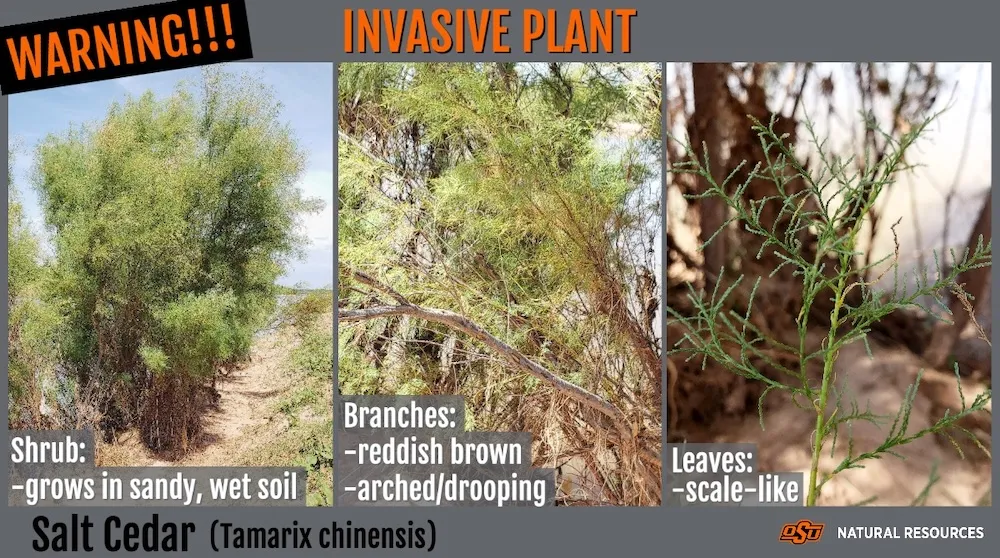
Saltcedar is an invasive shrub that grows in sandy soils near streams and rivers. It can grow in dense stands which limits the growth of important forage grasses, decreases water availability and even alters soil salinity levels. Control is difficult because these plants reproduce quickly and can resprout when cut. The herbicide imazapyr can be effective when applied on the leaves of plants that are less than 5 feet tall.
For more about invasive plants, see the Dirty Dozen Fact Sheet https://bit.ly/383fqfH
Multi-Species Grazing
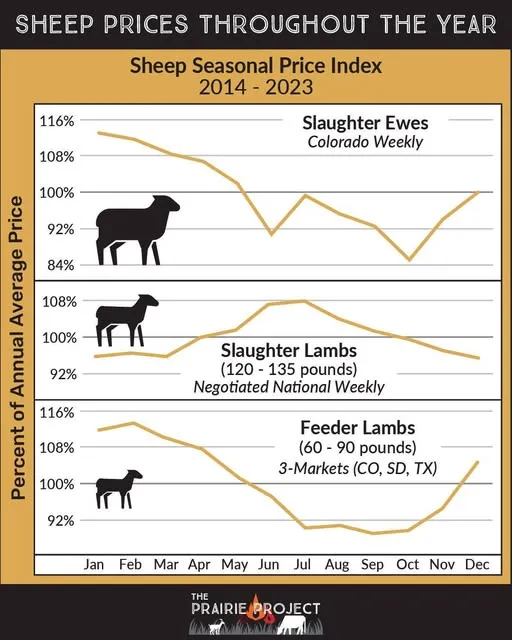
Sheep Prices Throughout the Year
Sheep Seasonal Price Index 2014 - 2023
Slaughter Ewes
Colorado Weekly
Highest in January, drops to lowest point in October and slowly rises back to average in December.
Slaughter Lambs (120 -135 pounds)
Negotiated National Weekly
Lowest in January slowly rises to a peak in June/July and decreases back down by December.
Feeder Lambs (60 -90 pounds)
3-Markets (CO, SD, TX)
Begins high in January, peaks in February and slowly declines to the lowest points July - October.
Woody Encroachment
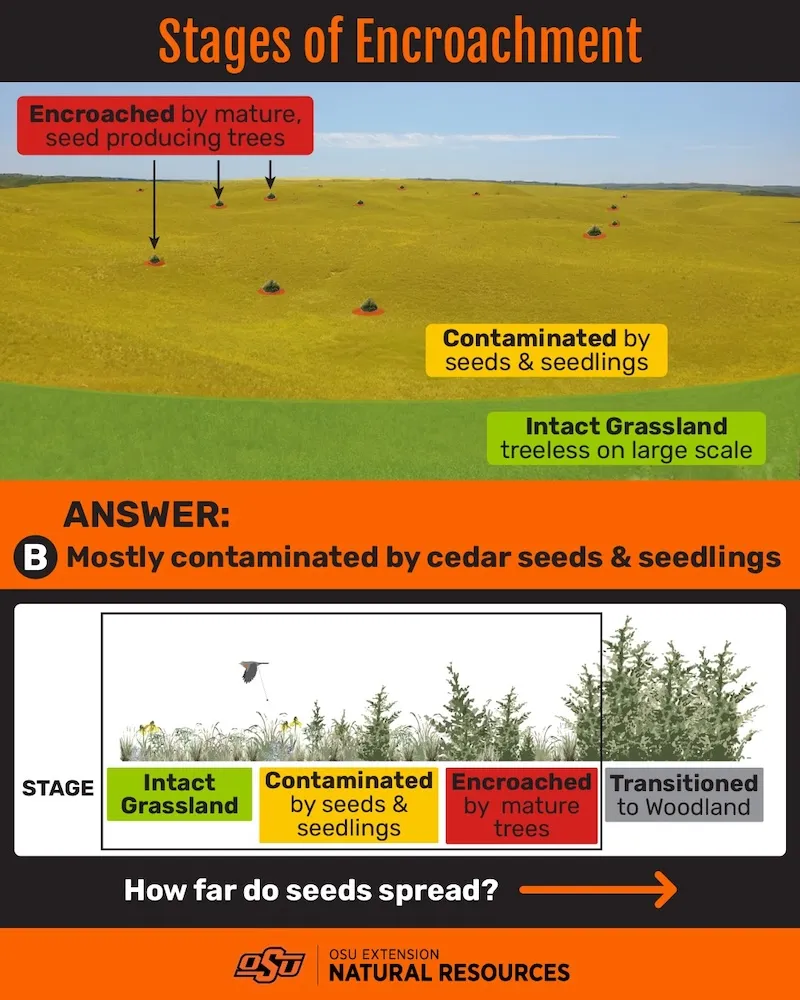
Is this Grassland at Risk?
Question: How would you describe this landscape?
A - Mostly intact grassland
B - Mostly contaminated by cedar seeds & seedlings
C - Mostly encroached by mature trees
???
Answer: B - Mostly contaminated by cedar seeds & seedlings
Stages of Encroachment
Cedar Seed Spread
200 yards - distance that seed spreads
26 acres - area one tree impacts
Action Steps
Read more here! https://www.theprairieproject.org
.webp)
Woody Encroachment
Is this Grassland at Risk?
Question: How would you describe this landscape?
A - Mostly intact grassland
B - Mostly contaminated by cedar seeds & seedlings
C - Mostly encroached by mature trees
???
Answer: B - Mostly contaminated by cedar seeds & seedlings
Stages of Encroachment
Cedar Seed Spread
Action Steps
Read more here! https://www.theprairieproject.org/
Multi-Species Grazing
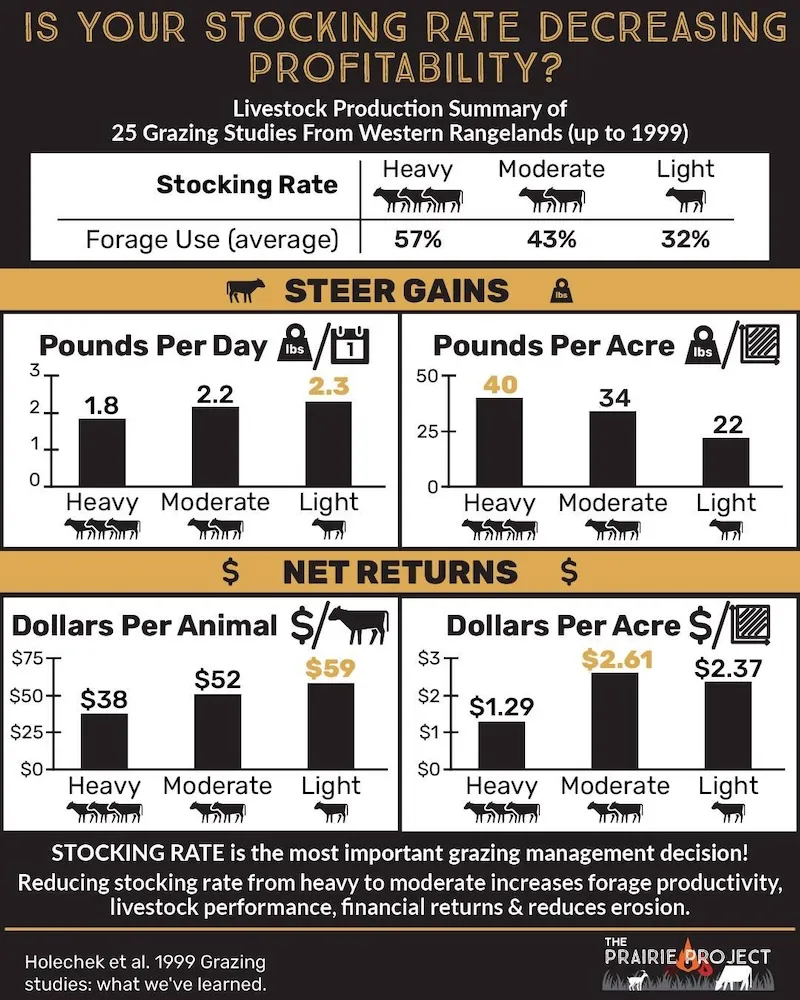
Is Your Stocking Rate Decreasing Profitability?
Livestock Production Summary of 25 Grazing Studies from Western Rangelands (up to 1999)
Heavy Stocking Rate: Forage Use (average) 57%
Moderate Stocking Rate: Forage Use (average) 43%
Light Stocking Rate: Forage Use (average) 32%
STEER GAINS: Pounds Per Day
STEER GAINS: Pounds Per Acre
NET RETURNS: Dollars Per Animal
NET RETURNS: Dollars Per Acre
STOCKING RATE is the most important grazing management decision!
Reducing stocking rate from heavy to moderate increases forage productivity, livestock performance, financial returns & reduces erosion.
Holechek et al. 1999 Grazing studies: what we've learned. https://bit.ly/Holechek1999
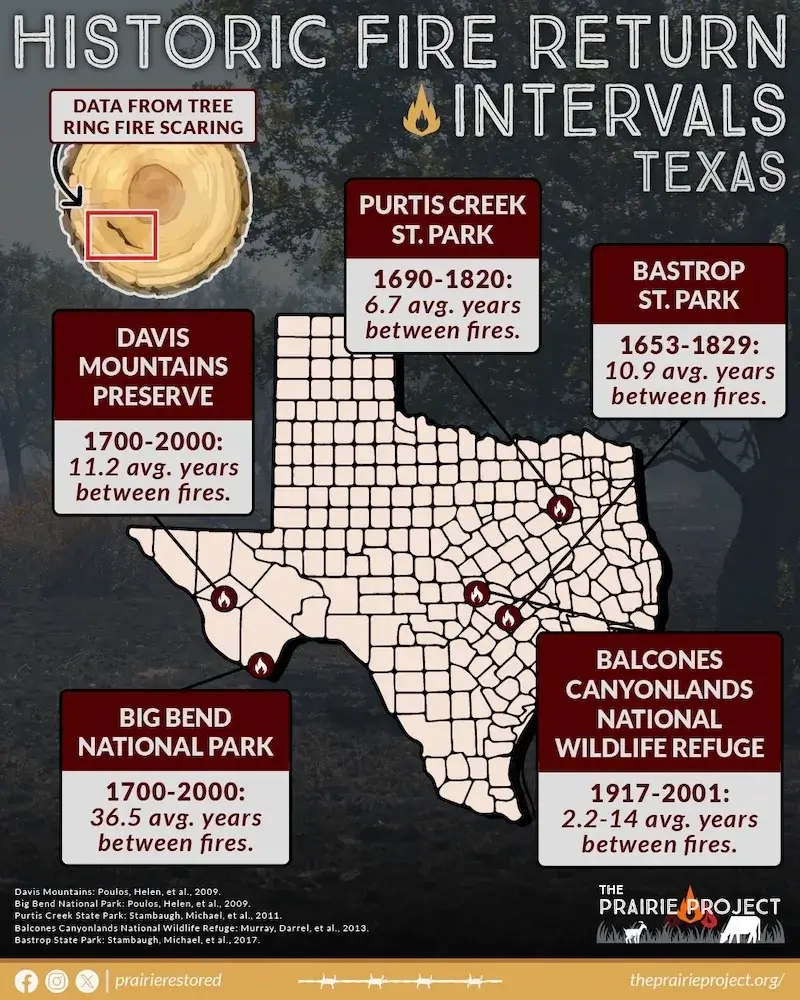
Prescribed Fire & Patch Burn Grazing
Historic Fire Return Interval - TEXAS
Data from Tree Ring Fire Scars
Davis Mountain Preserve
1700-200: 11.2 avg years between fires
Purtis Creek State Park
1690-1820: 6.7 avg. years between fires
Bastrop State Park
1653-1829: 10.9 avg. years between fires
Big Bend National Park
1700-2000: 36.5 avg years between fire
Balcones Canyonlands National Wildlife Refuge
1917-2001: 2.2-14 avg. years between fires
Davis Mountains: Poulos, Helen et al., 2009 https://doi.org/10.1139/X09-052
Big Bend National Park: Poulos, Helen, et al., 2009 https://doi.org/10.1139/X09-052
Purtis Creek State Park: Stambaugh, Michael, et al., 2011 https://doi.org/10.2111/REM-D-10-00128.1
Balcones Canyonlands National Wildlife Refuge: Murray, Darrel, et al., 2013 https://doi.org/10.1674/0003-0031-170.2.348
Bastrop State Park: Stambaugh, Michael, et al., 2017 https://doi.org/10.1016/j.foreco.2017.04.017
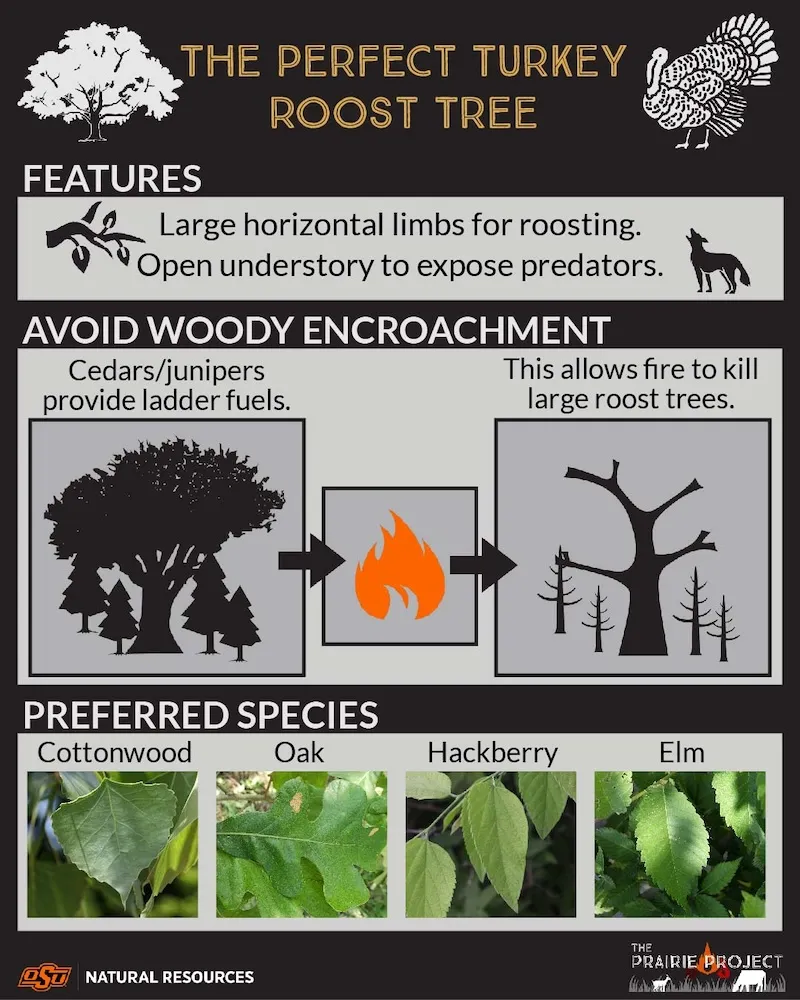
Wildlife Management
What makes the perfect turkey roost tree?
Features
Large horizontal limbs for roosting.
Open understory to expose predators.
Avoid Woody Encroachment
Cedars/junipers provide ladder fuels.
This allows fire to kill large roost trees.
Preferred Species
- Cottonwood
- Oak
- Hackberry
- Elm
To read more about managing habitat for wild turkey, click the link https://bit.ly/TurkeyMgtOSU