
Woody Encroachment
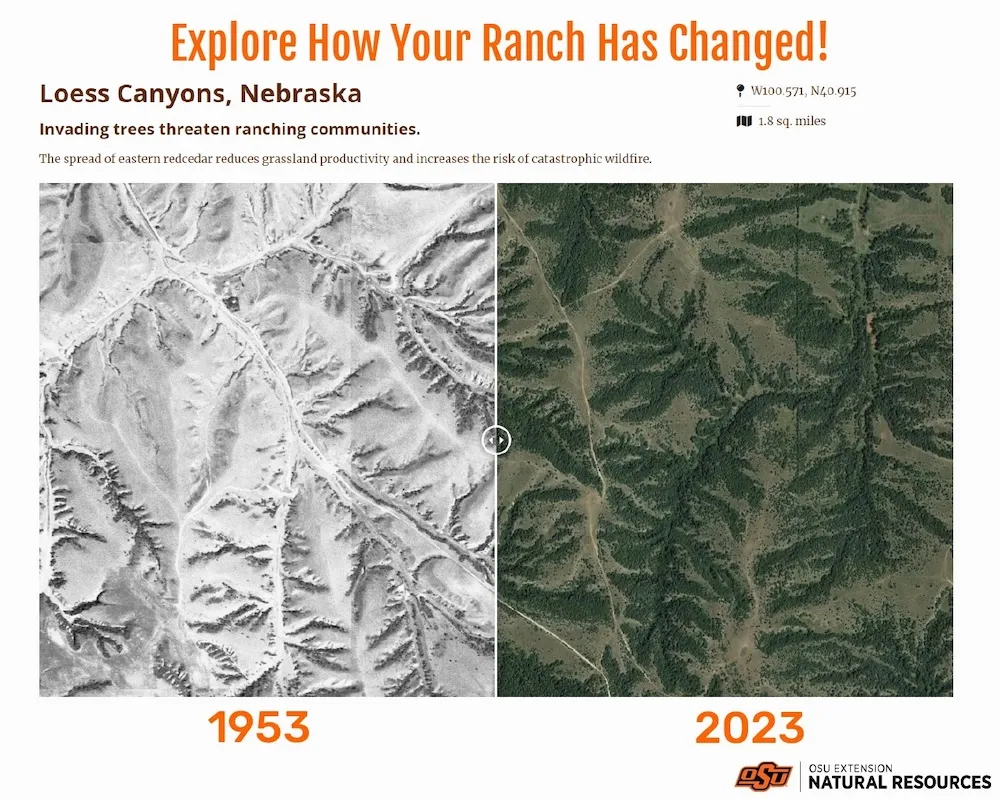
Explore how your ranch has changed!
Images show aerial photography from the 1950s compared against satellite imagery from Google Earth.
You can see woody encroachment and land conversion to crops and urban development.
Check out the Loess Canyons, Nebraska! https://bit.ly/LoessCanyonExplorer
Working Lands for Wildlife
.webp)
Woody Encroachment
Ranchers in the Loess Canyon are proving its possible to restore healthy grasslands by fighting trees with fire!
Over this Summer a 15 year study on prescribed fire was published which demonstrated:
-A reduction in tree cover from 50% to 10%
-An increase in plant diversity/abundance
-Grasses that sustained themselves for up to 15 years after the initial burn
In addition these prescribed fires were found to:
-Increase the number of American burying beetles
-Increase bird species richness by up to 65%
Because prescribed fires are such an advantageous tool the Prairie Project uses them in junction with livestock to help remove woody invasive plant species.
To read more on this article you can navigate to: https://www.discovermagazine.com/.../back-from-the-brink...
Oklahoma State University Natural Resources Extension #AgriLifeExtension Sonora Research Station Endowment Fund #brushmanagement #rangelands #precribedfire University of Nebraska-Lincoln
Multi-Species Grazing
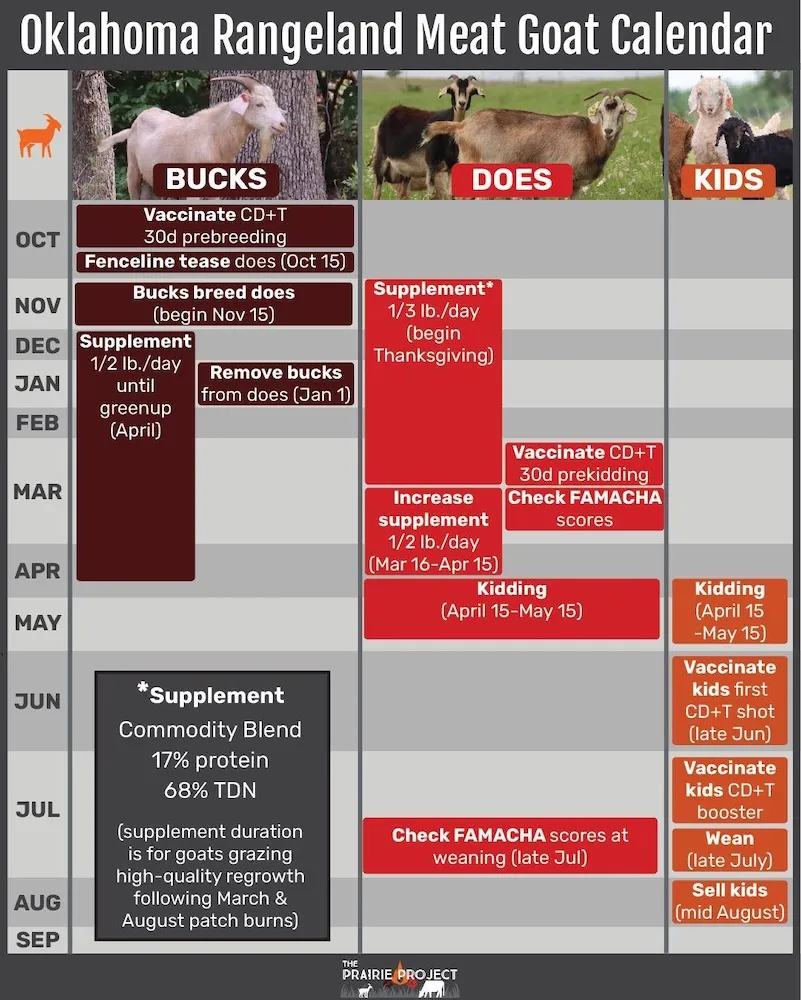
Oklahoma Rangeland Meat Goat Calendar
OCTOBER
Bucks
NOVEMBER
Bucks
Does
DECEMBER
Bucks
JANUARY
Bucks
MARCH
Does
APRIL
Does & Kids
JUNE
Kids
JULY
Kids
Does
AUGUST
Kids
Supplement: Commodity Blend - 17% protein, 68% TDN
(supplement duration is for goats grazing high-quality regrowth following March and August patch burns)
For more, check out the Meat Goat Manual! https://bit.ly/OSUMeatGoatManual
OSU Meat Goat
Texas A&M AgriLife Sheep and Goat Extension
Multi-Species Grazing
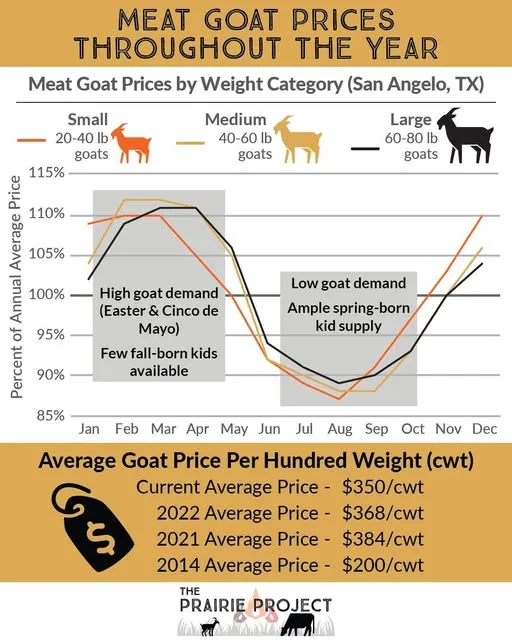
Meat Goat Prices Throughout The Year
Meat Goat Prices by Weight Category (San Angelo, TX)
Small: 20-40 lb goats
Medium: 40-60 lb goats
Large: 60-80 lb goats
January-April: 100% - 113% of annual average price
June-October: 87% - 95% of annual average price
Average Goat Price Per Hundred Weight (cwt)
Read more in the factsheet! https://bit.ly/OSUMeatGoatPrices
Multi-Species Grazing
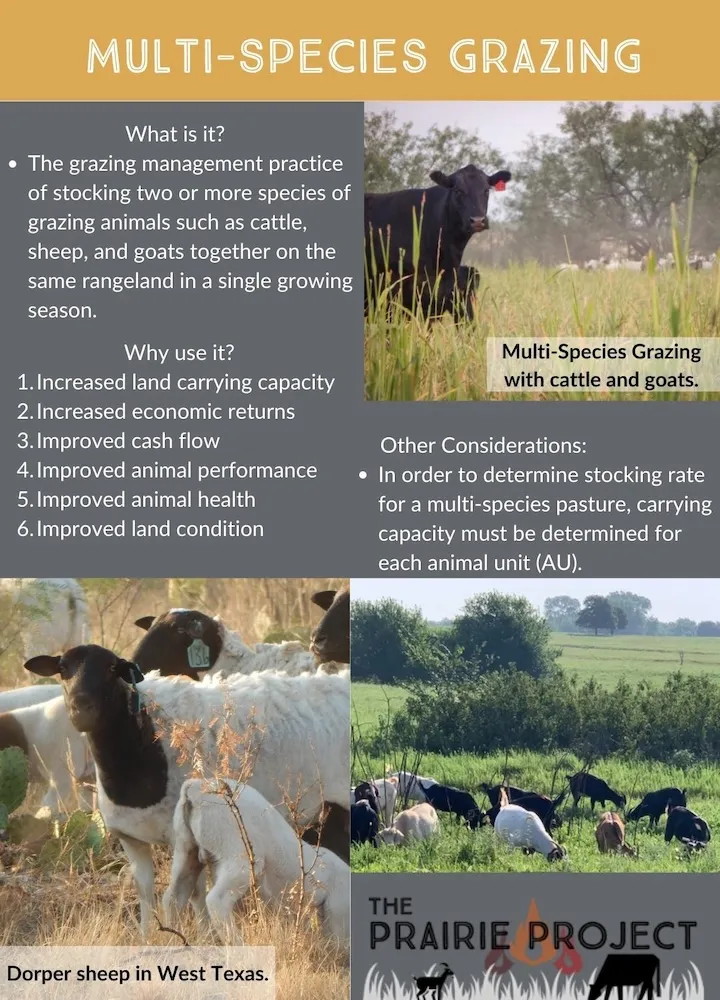
6 benefits of Multi-Species Grazing with goats, sheep, and cattle include:
Increased land carrying capacity
Increased economic returns
Improved cash flow
Improved animal performance
Improved animal health
Improved land condition
You can find carrying capacity & stocking rate calculations here: https://bit.ly/3hIl7bP
To read more on how the Prairie Project is using multi-species grazing to combat woody plant encroachment you can navigate to: https://bit.ly/3EvHERP
Oklahoma State University Natural Resources Extension West Texas Rangelands #rangelands #multispeciesgrazing #goats #sheep #cattle
Multi-Species Grazing
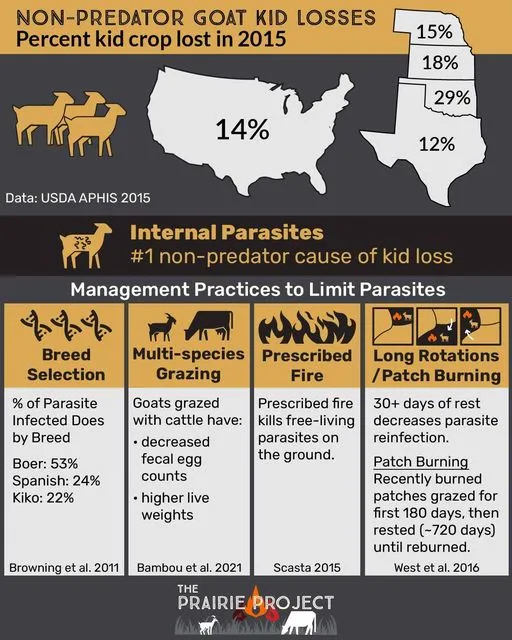
Non-Predator Goat Kid Losses
Percent kid crop lost in 2015
https://bit.ly/GoatLossUSDA_NAHMS2015
Internal Parasites: #1 non-predator cause of kid loss
Management Practices to Limit Parasites
Breed Selection
% of parasite infected does by breed
https://bit.ly/Browning_et_al_2011
Multi-species Grazing
goats grazed with cattle have:
https://bit.ly/Bambou_et_al_2021
Prescribed Fire
kills free-living parasites on the ground.
https://bit.ly/Scasta_2015
Long Rotations/Patch Burning
30+ days of rest decreases parasite reinfection
Patch Burning: Recently burned patches grazed for first 180 days, then rested (~720 days) until reburned.
https://bit.ly/West_et_al_2016
Multi-Species Grazing
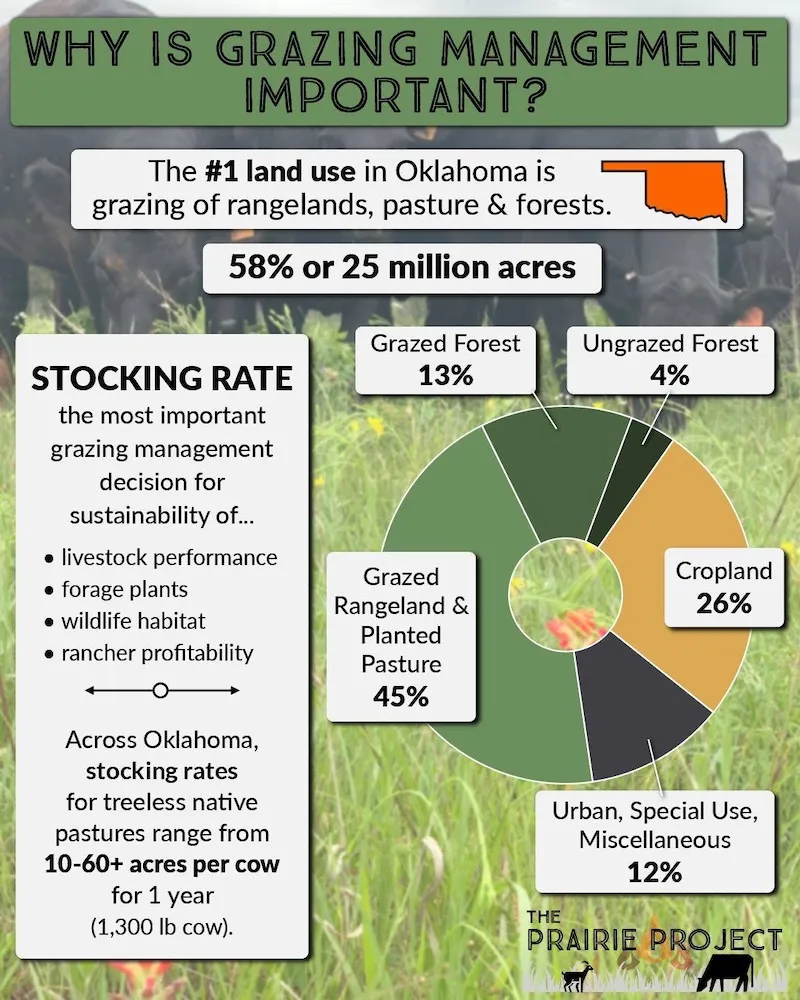
Why is grazing management important?
The #1 Land use in Oklahoma is grazing of Rangelands, Pasture and Forests
58% or 25 million acres
45% Grazed Rangeland & Planted Pasture
13% Grazed Forest
4% Ungrazed Forest
16% Cropland
12% Urban, special use, Miscellaneous
Stocking rate is the most important grazing management decision for sustainability of...
Across Oklahoma, stocking rates range from 10-60+ acres per cow for 1 year (1,300lb cow) on native pastures.
See stocking rates for your rangeland on the Rangeland Analysis Platform (link in bio)!
USDA land use data
Woody Encroachment
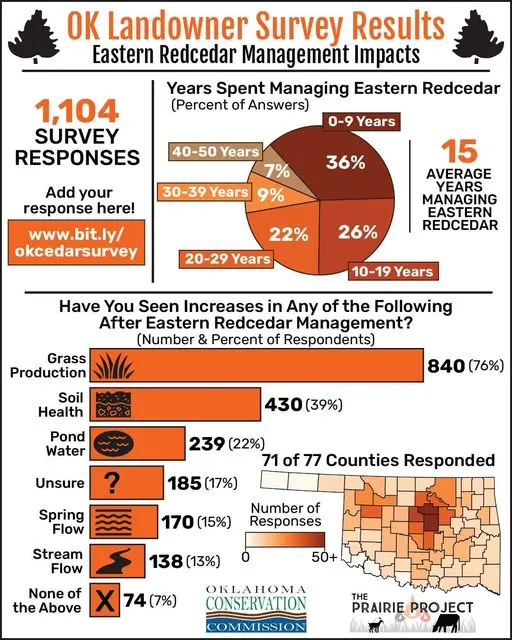
OK Landowner Survey Results
Eastern Redcedar Management Impacts
1,104 Survey Responses
Add your response here www.bit.ly/okcedarsurvey
Years Spent Managing Eastern Redcedar
(Percent of Answers)
0-9 years: 36%
10-19 years: 26%
20-29 years: 22%
30-39 years: 9%
40-50 years: 7%
15 Average Years Managing Eastern Redcedar
Have You Seen Increases in Any of the Following After Eastern Redcedar Management?
(Number & Percent of Respondents)
Grass Production: 840 (76%)
Soil Health: 430 (39%)
Pond Water: 239 (22%)
Unsure: 185 (17%)
Spring Flow: 170 (15%)
Stream Flow: 138 (13%)
None of the Above: 74 (7%)
71 of 77 Counties Responded
Multi-Species Grazing
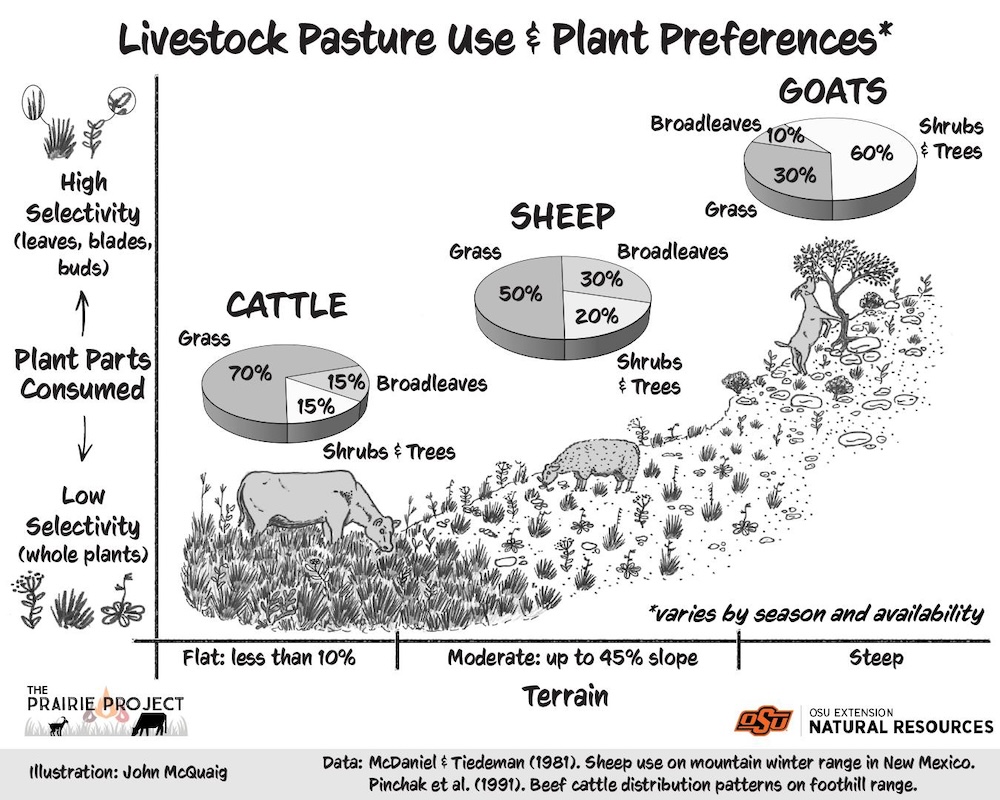
Does your livestock match your pasture?
Cattle, sheep and goats use pastures differently.
Grazing multiple species can often be complementary, resulting in broader use of available plant types and pasture terrain.
Illustration: John McQuaig
Data:
McDaniel & Tiedeman (1981). Sheep use on mountain winter range in New Mexico.
https://doi.org/10.2307/3898122
Pinchak et al. (1991). Beef cattle distribution patterns on foothill range.
https://doi.org/10.2307/4002956
Prescribed Fire & Patch Burn Grazing
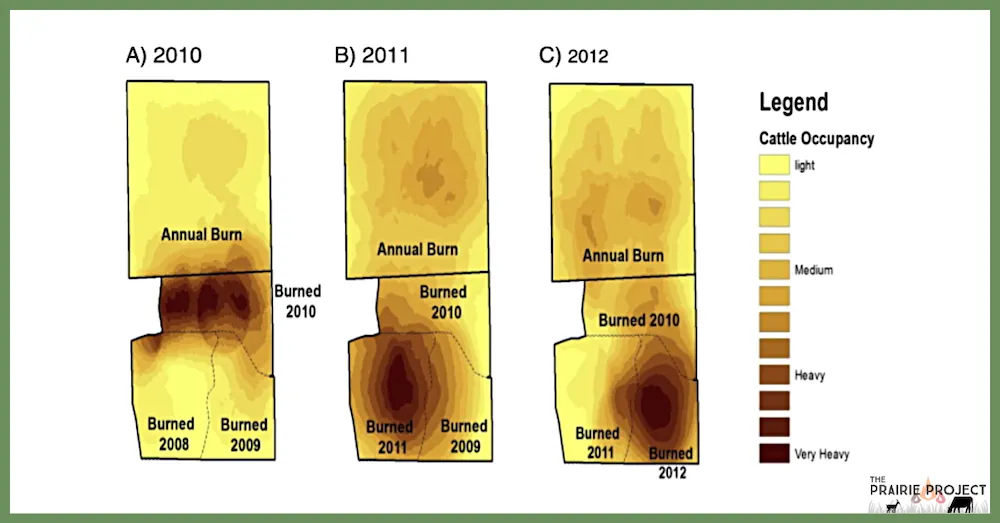
Patch burn research has shown that cattle use annually burned pastures differently than patch burned pastures.
A 2010-2012 study found that cattle occupied burned patches approximately 70% of the time, while cattle in annually burned areas occupied the pasture more uniformly. Livestock prefer grazing areas that have been recently burned because the plant regrowth provides nutritious and palatable forage.
Click the link to learn more from West et al. (2016) on Pyric-herbivory and Hydrological Responses in Tallgrass Prairie.
https://bit.ly/3nho0x8
Image from Rangeland Ecology & Management, Vol 69, Amanda L. West, Chris B. Zou, Elaine Stebler, Samuel D. Fuhlendorf, Brady Allred, Pyric-herbivory and Hydrological Responses in Tallgrass Prairie, pgs 20-27, Copyright 2016, with permission from Elsevier.
.webp)
Prescribed Fire & Patch Burn Grazing
Stockpiling for Drought Under Continuous Grazing?
Patch Burn Grazing
- One part (patch) of a pasture is burned.
- Cattle graze primarily on the most recent burn.
- When a new area is burned, cattle rotate themselves to the newest patch.
(Six weeks since fire. Burned Aug 5, 2022)
Forage Stockpiling
- Cattle avoid older burns.
- Forage is stockpiled for multiple years.
- 4,400 - 5,200 lbs/acre stockpiled after 2022 drought.
(2.5 years since fire. Burned Feb 2022)
During drought..
forage is available for grazing
fuel is available for burning
Prescribed Fire & Patch Burn Grazing
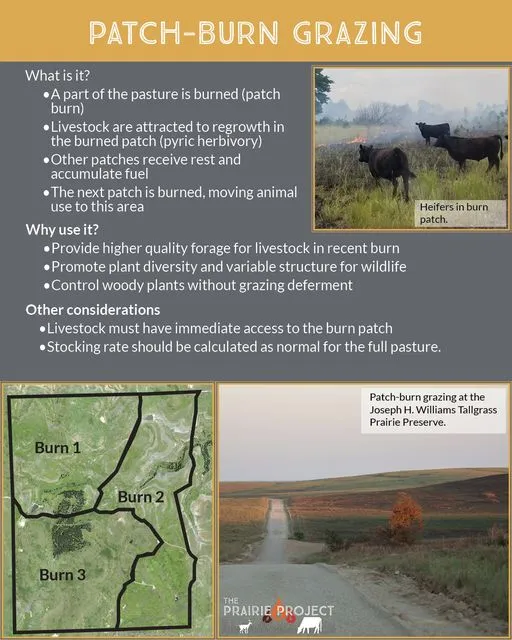
What is Patch Burn Grazing?
- A part of the pasture is burned (patch burn)
- Livestock are attracted to regrowth in the burned patch (pyric herbivory)
- Other patches receive rest and accumulate fuel
- The next patch is burned, moving animal use to this area
Why use it?
- Provide higher quality forage for livestock in recent burn
- Promote plant diversity and variable structure for wildlife
- Control woody plants without grazing deferment
Other considerations
- Livestock must have immediate access to the burn patch
- Stocking rate should be calculated as normal for the full pasture
.webp)
Wildlife Management
Bobwhite, Burning & Bovines
Patch Burn Grazing Benefits Northern Bobwhite Broods!
SITE SELECTION
Broods selected areas with... greater proportions of native grass managed with burning & grazing
SURVIVAL
Brood survival was greater where native grass as burned & grazed within the last two growing seasons.
Broods that survived to 35 days showed stronger selection for shrub cover than broods that failed.
Batch Burned & Grazed Native Grassland
Patch burning increases broadleaf plants providing cover, seeds, and insects (food).
cover: from predators & weather
seeds: foood for adults
insects: food for chicks
Northern Bobwhite broods had greater selection for AND survival on patch burned & grazed sites.
Thompson et al. 2022 Northern Bobwhite Demographics and Resource Selection Are Explained by Prescribed Fire with Grazing and Woody Cover in Southwest Missouri https://trace.tennessee.edu/nqsp/vol9/iss1/9/
Prescribed Fire & Patch Burn Grazing
Bobwhite, Burning & Bovines
Patch Burn Grazing Benefits Northern Bobwhite Broods!
SITE SELECTION
Broods selected areas with... greater proportions of native grass managed with burning & grazing
SURVIVAL
Brood survival was greater where native grass as burned & grazed within the last two growing seasons.
Broods that survived to 35 days showed stronger selection for shrub cover than broods that failed.
Batch Burned & Grazed Native Grassland
Patch burning increases broadleaf plants providing cover, seeds, and insects (food).
cover: from predators & weather
seeds: foood for adults
insects: food for chicks
Northern Bobwhite broods had greater selection for AND survival on patch burned & grazed sites.
Thompson et al. 2022 Northern Bobwhite Demographics and Resource Selection Are Explained by Prescribed Fire with Grazing and Woody Cover in Southwest Missouri [https://trace.tennessee.edu/nqsp/vol9/iss1/9/](https://trace.tennessee.edu/nqsp/vol9/iss1/9/)
Prescribed Fire & Patch Burn Grazing
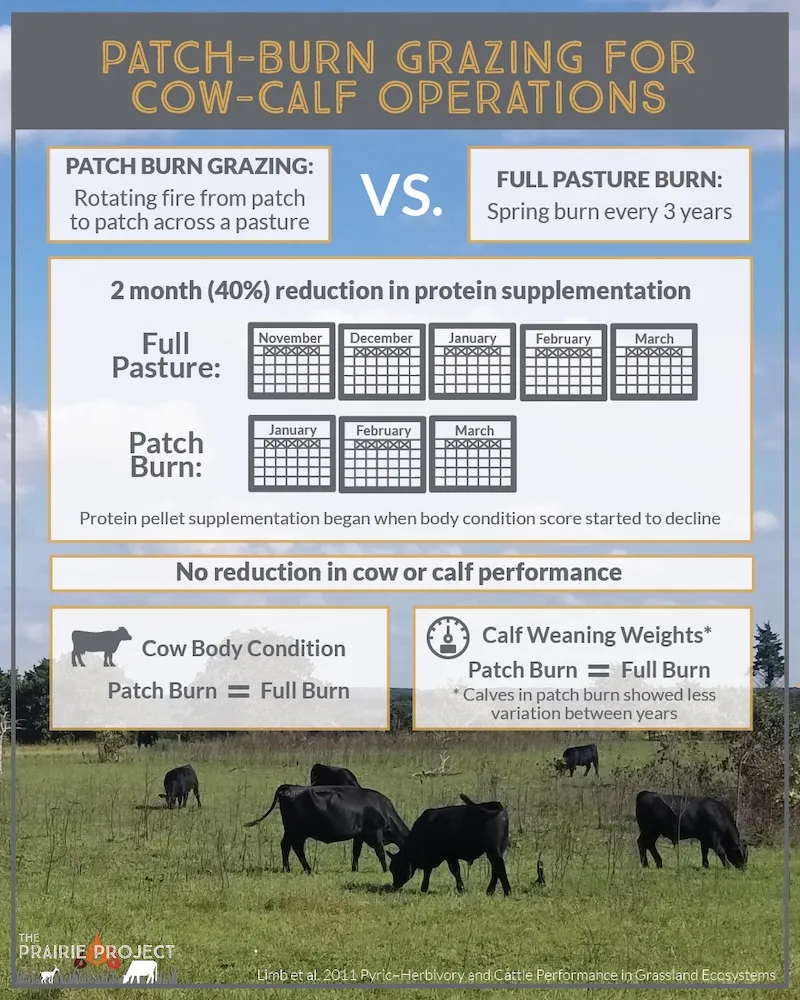
Patch-Burn Grazing for Cow-Calf Operations
Patch Burn Grazing: Rotating fire from patch to patch across a pasture VS. Full Pasture Burn: Spring burn every 3 years
2 month (40%) reduction in protein supplementation
- Full Pasture Burn: November, December, January, February, March
- Patch Burn: January, February, March
Protein supplementation began when body condition score started to decline
No reduction in cow or calf performance
- Cow body condition: Patch burn = full burn
- Calf weaning weights*: Patch burn = full burn
*Calves in patch burn showed less variation between years
Research published here -> Limb et al. 2011 Pyric-Herbivory and Cattle Performance in Grassland Ecosystems https://doi.org/10.2111/REM-D-10-00192.1
Prescribed Fire & Patch Burn Grazing
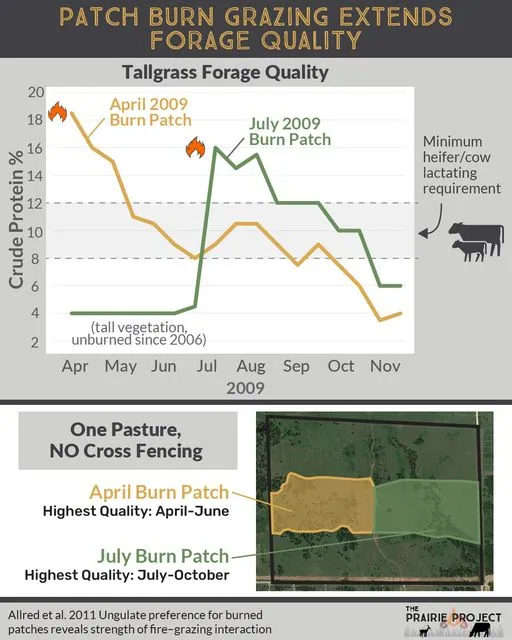
Patch Burn Grazing Extends Forage Quality
Tallgrass Forage Quality: April -November 2009
- April 2009 Burn Patch: Crude protein is high (18%) after fire in April and slowly declines as the growing season ends (less than 8% by October).
- July 2009 Burn Patch: Crude protein begins very low (4%) in tall vegetation that was unburned since 2006. Fire in July causes an increase in crude protein (16%) and a slow decline, staying moderate (8-10%), through October.
One Pasture, NO cross fencing.
April Burn Patch- Highest Quality: April-June
July Burn Patch - Highest Quality: July-October
Allred et al. 2011 Ungulate preference for burned patches reveals strength of fire�grazing interaction https://doi.org/10.1002/ece3.12
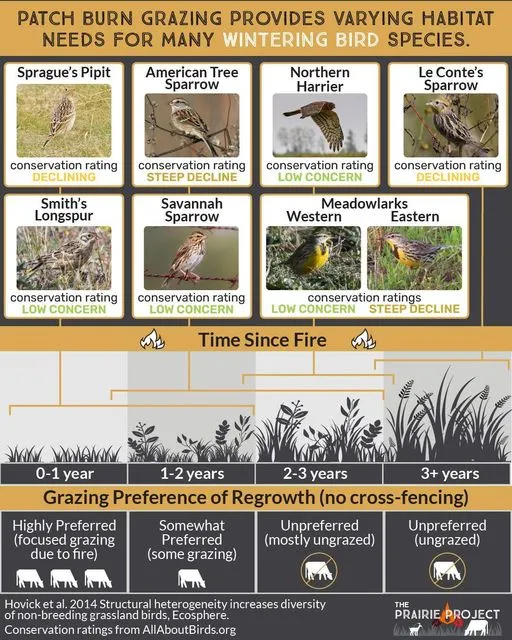
Wildlife Management
Patch Burn Grazing Provides Varying Habitat Needs for Many WINTERING BIRD Species.
Sprague's Pipit: Declining conservation rating
Smith's Longspur: Low Concern conservation rating
- Time Since Fire: 0-2 years
- Grazing Preference: highly preferred (focused grazing due to fire & somewhat preferred (some grazing)
American Tree Sparrow: Steep Decline conservation rating
Savannah Sparrow: Low Concern conservation rating
- Time Since Fire: 1-3 years
- Grazing Preference: somewhat preferred (some grazing) & unpreferred (mostly ungrazed)
Norther Harrier: Low Concern conservation rating
Western Meadowlark: Low Concern conservation rating
Eastern Meadowlark: Steep Decline conservation rating
- Time Since Fire: 2-3 years
- Grazing Preference: unpreferred (mostly ungrazed)
Le Conte's Sparrow: Declining conservation rating
- Time Since Fire: 3+ years
- Grazing Preference: unpreferred (ungrazed)
Data: Hovick et al. 2014 Structural heterogeneity increases diversity of non-breeding grassland birds, Ecosphere. https://doi.org/10.1890/ES14-00062.1
.webp)
Prescribed Fire & Patch Burn Grazing
Are horn flies causing problems for your cattle? Research indicates that patch burn grazing could help!
Horn flies are a costly parasite to livestock production. They can increase stress, cause weight loss, and result in blood loss to the animal. While insecticides are the primary method for control, over time horn flies can develop resistance to the effective agents.
In a 2012 study by Scasta et al., management systems featuring patch burn grazing resulted in 41% less horn flies on cattle compared to traditional systems in both Iowa and Oklahoma sites. These findings indicate that the interaction between fire and grazing animals could be a possible tool to address horn flies as chemical control measures become less effective.
Access the full article at [https://bit.ly/2Owo3tp](https://bit.ly/2Owo3tp).
.webp)
Wildlife Management
Patch Burn Grazing provides ideal habitat for Greater Prairie Chicken
What is Patch Burn Grazing?
FIRE
- Pasture is divided into patches
- Each patch is burned in a different year on a rotation
GRAZING
- Cattle have immediate access to all patches
- Cattle are attracted the the high quality regrowth on the recently burned patch
- Older burn patches receive 1.5+ years of rest
Prairie Chicken Habitat
LEKKING
0-1 years since fire
Highly Preferred Grazing
- Heavily grazed
- Keeps regrowth short
NESTING
2+ years since fire
Unpreferred Grazing
- Ungrazed
BROODING
1-2 years since fire
Moderate Preference Grazing
- Mostly ungrazed
Hovick et al. 2015 Weather Constrains the Influence of Fire and Grazing on Nesting Greater Prairie-Chickens. https://doi.org/10.1016/j.rama.2015.01.009
Prescribed Fire & Patch Burn Grazing
Patch Burn Grazing provides ideal habitat for Greater Prairie Chicken
What is Patch Burn Grazing?
FIRE
- Pasture is divided into patches
- Each patch is burned in a different year on a rotation
GRAZING
- Cattle have immediate access to all patches
- Cattle are attracted the the high quality regrowth on the recently burned patch
- Older burn patches receive 1.5+ years of rest
Prairie Chicken Habitat
LEKKING
0-1 years since fire
Highly Preferred Grazing
- Heavily grazed
- Keeps regrowth short
NESTING
2+ years since fire
Unpreferred Grazing
- Ungrazed
BROODING
1-2 years since fire
Moderate Preference Grazing
- Mostly ungrazed
Hovick et al. 2015 Weather Constrains the Influence of Fire and Grazing on Nesting Greater Prairie-Chickens. [https://doi.org/10.1016/j.rama.2015.01.009](https://doi.org/10.1016/j.rama.2015.01.009)
Prescribed Fire & Patch Burn Grazing
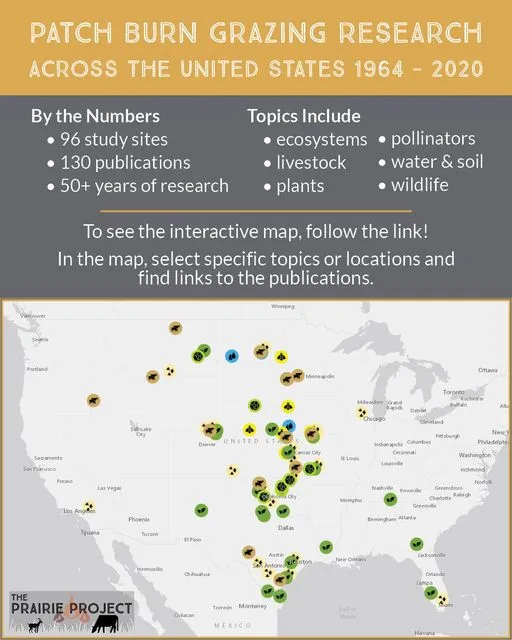
Patch burn grazing research across the United States 1964 - 2020
To see the interactive map, follow the link! https://bit.ly/PBG_Map
In the map, select specific topics of locations and find links to the publications.
By the numbers
- 96 study sites
- 130 publications
- 50+ years of research
Topics include
- Ecosystems
- Livestock
- Plants
- Pollinators
- Water & soil
- Wildlife

Prescribed Fire & Patch Burn Grazing
Stocker cattle grazing spring-burned pastures gained more weight.
Stocker Cattle Gains on Patch Burned Pastures
Total Study Area: ~11,000 acres
Spring Burn Pastures (Mar/Apr Burns)
vs.
Late Summer Burn Pastures (Aug/Sept Burns)
3 patches/pasture, 1 patch burned/year
(Dashed lines indicate patch boundaries, no interior fences).
Yearling Stocker Cattle: 5,950 over 3 years
Grazing Season: Apr-Sept with no pasture rotation
Days on Recent Burn
- Spring Burn Steers: 150-180
- Late Summer Burn Steers: 15-30
- Difference: 135-150
Season Long Gain (lbs/head)
- Spring Burn Steers: 349
- Late Summer Burn Steers: 297
- Difference: 52
Average Daily Gain (lbs/head)
- Spring Burn Steers: 1.9
- Late Summer Burn Steers: 1.6
- Difference: 0.3
Total Pounds of Gain (lbs over 3 years)
- Spring Burn Steers: 1,038,275
- Late Summer Burn Steers: 883,575
- Difference: 154,700
Gross Profit Difference (at $1.32/lb): $205,400
McMillan et al. 2022 Does fire and herbicide benefit cattle production in invaded grassland landscapes? [https://doi.org/10.1016/j.agee.2022.108163](https://doi.org/10.1016/j.agee.2022.108163)
Prescribed Fire & Patch Burn Grazing
Yearling stocker cattle performance was equal in annually burned and patch burned pastures during normal and wet years. In dry years (2011, 2012) stockers grazing patch burn pastures gained more than those grazing on annually burned pastures.
�cattle on PB had a greater ADG (P = 0.02; 0.10 kg/d), final weight (P = 0.07; 12 kg), and total BW gain (P = 0.02; 11.8 kg) in low precipitation years (2011 and 2012). Overall, patch burning provides similar BW gains as yearly burning on native tall-grass prairie, while providing a BW gain advantage in low precipitation years.�
Link: [https://doi.org/10.15232/pas.2016-01574](https://doi.org/10.15232/pas.2016-01574)

Prescribed Fire & Patch Burn Grazing
An 11-year study compared stocker performance in patch burned pastures versus traditionally managed pastures in western Oklahoma at OSU�s Marvin Klemme Range Research Station. Researchers found that from 1999-2001 there was no statistical difference in stocker weight gains in the traditionally managed versus patch burned pastures.
In 2002, the stockers in the patch burn pastures started gaining more weight and continued to gain more weight through the end of the study in 2009 (Limb et al. 2011). By 2002 the full rotation of burning had been completed in all patches and the full benefits from patch burning were captured by the grazing steers.
The Prairie Project
[http://bit.ly/PyricHerbivoryLimb2011](http://bit.ly/PyricHerbivoryLimb2011)
.webp)
Prescribed Fire & Patch Burn Grazing
In abnormally dry years you can keep cattle weights stable by working with the landscape!
Rainfall and stocking rate are two of the most important factors in livestock production. Although annual precipitation cannot be controlled, negative effects of a dry year can be lessened through patch burning. Burned patches increase forage quality, while unburned areas provide more pounds of available forage. Producers can benefit from forage variation by influencing this fire-grazing interaction.
To learn more about stabilizing livestock productivity in a changing climate, click the link below!
https://bit.ly/31ExM4L See less